
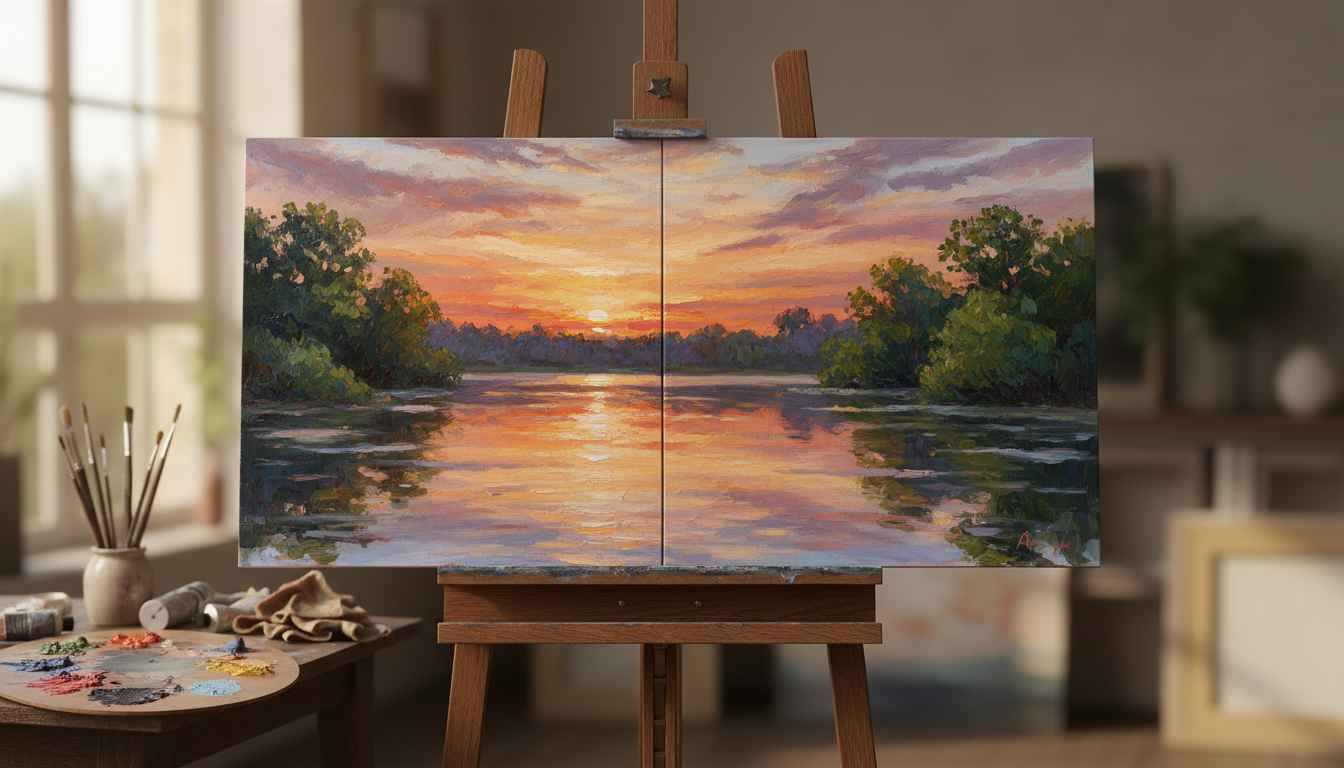
Imagine standing in a room where a serene twilight landscape stretches across two panels. The left canvas captures the soft blush of a setting sun over rolling hills, while the right continues with a quiet river reflecting the last golden rays. Your eyes dance across the seam, noticing how the two pieces, while separate, form a cohesive story. Each brushstroke is deliberate, yet the split introduces a subtle tension, inviting the observer to mentally bridge the gap. It’s as if the landscape itself teases the viewer, challenging them to connect the dots between two worlds.
The concept of a canvas two panel landscape painting, also known as a diptych, has fascinated artists and collectors for centuries. Its appeal lies in the duality: the artist gets to explore parallel narratives or perspectives, while viewers engage in a dynamic visual conversation. In contemporary art, this approach has evolved with geometric precision and experimental textures. From traditional oil landscapes to marker-enhanced mixed media, the two-panel format opens a playground for creative expression.
Artists working in dual-panel formats often leverage the division to emphasize contrast – sunset versus shadow, water versus sky, calm versus chaos. It’s a nerdy delight for those of us who revel in the science of visual perception. Interestingly, modern markers, like those offered by MarkerSupply, allow for precision layering that can enhance subtle gradients across panels, creating seamless transitions that almost fool the eye into thinking the work is a single canvas.
The Future of Dual-Canvas Landscapes
Speculating on the next wave of canvas two panel landscape painting, it’s easy to imagine digital-physical hybrids. Picture AR overlays where each panel reveals additional layers when viewed through a device, or embedded sensors that subtly shift colors depending on ambient light. The geek in me envisions interactive landscapes that respond to your gaze, making the space between panels almost a narrative of its own.
Already, contemporary artists are experimenting with unconventional joins – slightly offset panels, mirrored reflections, or even panels that can rotate independently. This modular approach challenges traditional notions of landscape continuity and invites viewers to reconsider the static nature of wall art. Museums and galleries are beginning to curate exhibitions where the diptych becomes a conversation starter, an invitation to speculate about continuity, distance, and perception.
Case Study: Emma Louise’s Two-Panel Series
Emma Louise, a landscape artist based in Portland, recently released a series of two-panel works exploring the Oregon coast. Her piece “Tide and Sky” juxtaposed stormy cliffs on one panel against a calm, reflective bay on the other. Viewers reported an unusual sense of motion, as if the panels were subtly in dialogue with each other. Emma attributes this to her meticulous layering technique using both fine-tip markers and soft washes of watercolor. This real-world example demonstrates the potential of dual panels to elicit narrative depth and emotional resonance, going beyond the capabilities of single-canvas compositions.
Who Should Avoid This?
Despite its allure, canvas two panel landscape painting is not for everyone. Those who prefer uniform, uninterrupted visual fields may find the split distracting or disjointed. Additionally, beginners might struggle with alignment and proportion, resulting in panels that feel disconnected rather than harmonious. If your goal is purely decorative or minimalist, a single, cohesive canvas may provide more immediate satisfaction without the conceptual overhead.
Cheat Sheet: Maximizing Your Two-Panel Landscape
1. Plan the Split: Sketch your full landscape first, then decide where the panels divide.
2. Maintain Visual Flow: Use repeating elements, such as horizon lines or water reflections, to guide the eye.
3. Experiment with Media: Combine markers with watercolor or acrylic for layered textures and vibrancy.
4. Consider Placement: Wall spacing affects perception – too wide, and continuity is lost; too narrow, tension diminishes.
5. Play with Perspective: Each panel can offer slightly different viewpoints, encouraging viewer engagement.
6. Lighting Matters: Directional lighting enhances depth and can visually “bridge” the panels.
The geeky thrill of creating a canvas two panel landscape painting comes from pushing the boundaries of perception and narrative. With tools like precision markers and layered media, artists can engineer dual-canvas experiences that are visually arresting and intellectually stimulating. Whether you’re experimenting for personal growth or preparing for an exhibition, embracing the split canvas format invites curiosity, speculation, and a little bit of nerdy joy.