
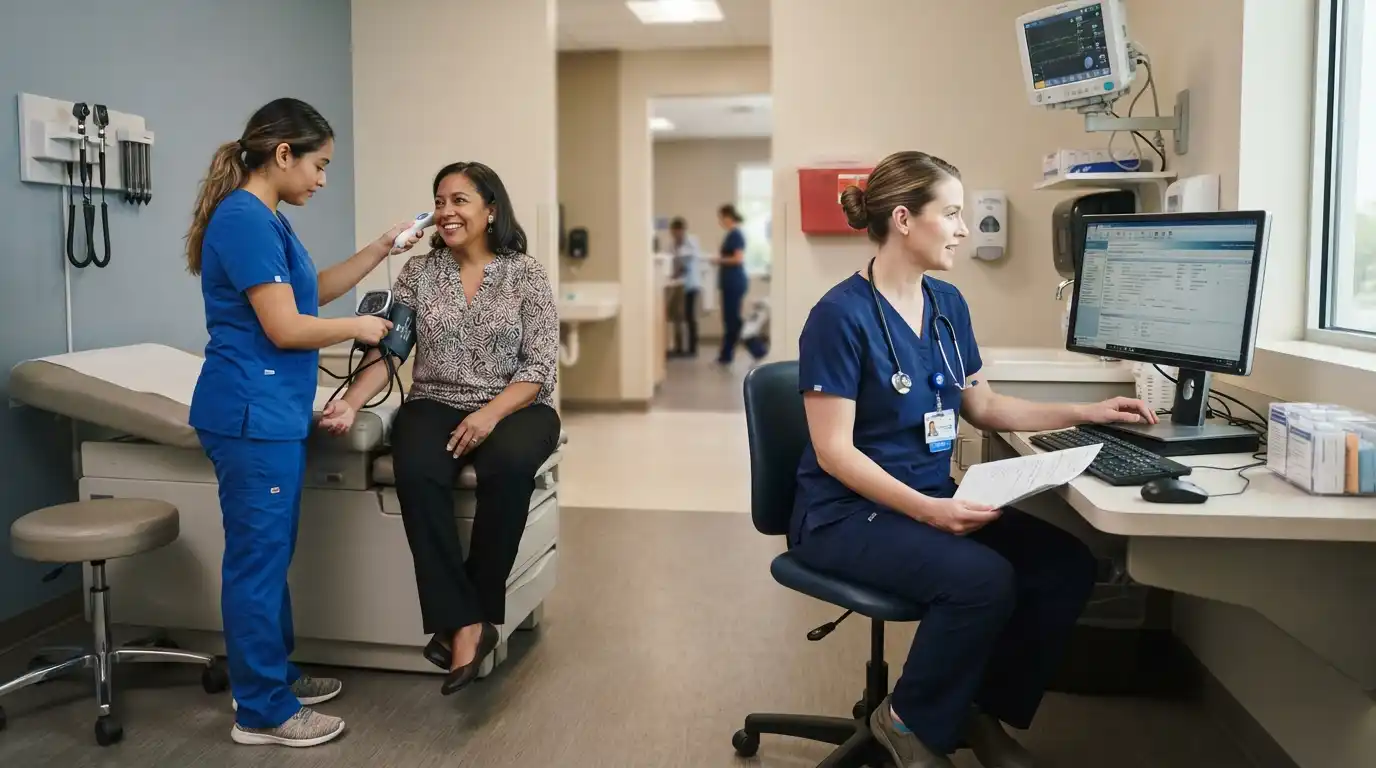
Medical assisting generally combines administrative and clinical support duties, while registered nursing involves a broader level of patient assessment, care planning, treatment, education, and clinical responsibility. Both roles contribute to patient care, but they do so in different ways.
Medical Assisting vs Nursing: The Basic Difference
The simplest way to understand the difference is to look at the role each professional plays within a healthcare team.
Medical assistants commonly support physicians and other healthcare professionals with tasks such as recording patient information, checking vital signs, preparing examination rooms, scheduling appointments, maintaining records, and assisting with certain clinical procedures according to their training, employer policies, and applicable state requirements.
Registered nurses have a broader clinical role. They assess patients, monitor changes in health conditions, administer medications and treatments within their scope of practice, coordinate care, educate patients and families, and collaborate with physicians and other healthcare professionals.
This distinction is important because the two careers should not be viewed simply as different levels of the same job. They are separate healthcare occupations with different educational and professional pathways.
What Does a Medical Assistant Do?
Medical assistants often serve as an important connection between patients, physicians, and the administrative side of a healthcare practice.
The exact duties can vary by employer, medical specialty, state regulations, and workplace. A medical assistant may perform a combination of clinical and administrative responsibilities.
Common Clinical Responsibilities
- Recording patient vital signs
- Preparing patients for examinations
- Updating medical histories and patient information
- Preparing examination rooms
- Collecting certain specimens
- Assisting healthcare professionals during examinations
- Performing other permitted clinical tasks based on training and local requirements
Common Administrative Responsibilities
- Scheduling appointments
- Updating patient records
- Handling forms and documentation
- Communicating with patients about appointments
- Managing office supplies
- Supporting billing and insurance-related administrative processes
This combination can make medical assisting attractive to people who enjoy both patient interaction and organized office work.
What Does a Registered Nurse Do?
Registered nurses have a substantially broader clinical responsibility. Their work can involve direct patient care, clinical assessment, treatment, education, coordination, and communication with the wider healthcare team.
Depending on the setting and their specialty, nurses may care for patients in hospitals, outpatient facilities, physician offices, schools, home healthcare, long-term care environments, and other healthcare settings.
Common Nursing Responsibilities
- Assessing patients and monitoring their conditions
- Documenting symptoms and medical information
- Administering medications and treatments within their scope of practice
- Contributing to patient care plans
- Operating and monitoring medical equipment
- Educating patients and families
- Communicating with physicians and other healthcare professionals
- Supporting patients during recovery and ongoing treatment
Nursing can also lead into numerous specialties, including emergency nursing, pediatric nursing, critical care, surgical nursing, community health, oncology, mental health, and other areas of patient care.
Medical Assistant vs Nurse: Education Requirements
One of the biggest differences between medical assisting and nursing is the educational pathway.
Medical assisting programs can often be completed in a relatively short period. Certificate and diploma programs may provide instruction in areas such as medical terminology, anatomy, pharmacology, clinical procedures, administrative processes, and patient communication. Some employers may also provide on-the-job training.
Nursing requires a more extensive professional education. Registered nurses may enter the profession through an approved nursing diploma program, an associate degree in nursing, or a bachelor’s degree in nursing. Nursing programs include classroom education as well as supervised clinical experience.
Education is only part of the distinction. Registered nurses must also satisfy licensing requirements before practicing as nurses.
Medical Assisting vs Nursing: Licensing and Certification
The credentialing process is another major difference.
Medical assistants may pursue professional certification, depending on their career goals and employer expectations. Certification can demonstrate knowledge and professional preparation, although requirements vary between employers and jurisdictions.
Registered nursing is a licensed profession. Individuals must meet the applicable educational and examination requirements before practicing as registered nurses.
Because healthcare regulations can differ by state, anyone considering either career should check the requirements that apply to the location where they plan to work.
Medical Assisting vs Nursing: Work Environment
The work environment can strongly influence which career feels like a better fit.
Medical assistants frequently work in physician offices, outpatient clinics, specialty practices, and other ambulatory healthcare environments. Many positions operate around standard business hours, although schedules can vary.
Nurses work across a much wider range of healthcare environments. Hospitals, outpatient facilities, nursing facilities, schools, home healthcare organizations, and specialty centers may employ nurses.
Hospital nursing can involve rotating shifts, nights, weekends, holidays, and extended periods of standing or walking. Other nursing positions may provide more conventional schedules.
If predictable office-style scheduling is a major priority, medical assisting may offer more opportunities that align with that preference. If you want exposure to different clinical environments and are comfortable with variable schedules, nursing can provide a broader range of possibilities.
Medical Assisting vs Nursing: Salary Differences
Compensation is another factor people consider when comparing these careers.
Medical assistant salaries can vary based on geographic location, specialty, experience, employer, certification, and workplace type. Nursing compensation also varies significantly according to location, specialty, experience, education, employer, and shift structure.
Registered nursing generally carries a higher compensation range because it requires a broader clinical scope, professional licensure, and more extensive education. However, salary should be evaluated alongside education costs, career progression, schedule, responsibilities, and personal goals.
For people interested in healthcare careers without committing immediately to a longer professional education pathway, medical assisting can provide an accessible starting point. Nursing may offer greater opportunities for specialization and advancement over the longer term.
Career Growth and the Future of Healthcare Roles
The future of healthcare employment is closely connected to population needs, aging demographics, chronic disease management, technological change, outpatient care, and the growing complexity of healthcare delivery.
Medical assistants can benefit from continued demand for healthcare services because physicians and healthcare organizations need support staff who can help manage routine clinical and administrative work.
Nurses are also positioned within a broad and diverse healthcare workforce. As healthcare organizations expand services and patients require increasingly coordinated care, nurses can continue to work across numerous specialties and settings.
The future therefore is not necessarily about one profession replacing the other. Medical assistants and nurses perform different functions, and modern healthcare organizations often depend on multiple professional roles working together.
How Technology May Change Both Careers
Technology is changing healthcare workplaces, but that does not automatically mean clinical support roles will disappear.
Electronic health records, automated appointment systems, digital communication platforms, remote monitoring, artificial intelligence, and other technologies can reduce repetitive administrative tasks and change how healthcare professionals manage information.
Medical assistants may increasingly work with digital records, patient communication platforms, automated scheduling tools, and technology-assisted clinical workflows.
Nurses may increasingly use electronic documentation, remote monitoring systems, clinical decision-support tools, connected medical devices, and other digital technologies.
The strongest long-term advantage for either profession may come from adaptability. Healthcare workers who are comfortable learning new systems and maintaining strong communication and patient-care skills can remain valuable as technology changes the workplace.
Medical Assisting vs Nursing: Career Advancement
Career progression looks different for each occupation.
Medical assistants can develop experience in specialty practices, administrative coordination, clinical support, patient services, and healthcare operations. Additional education or certifications can also support career transitions.
Nursing provides a broader formal pathway for specialization. Registered nurses may pursue advanced education and move toward specialized clinical positions, leadership, education, case management, or advanced practice roles depending on their qualifications and professional goals.
This makes it important to think beyond the first job. A career decision should consider where you want your professional life to be several years from now.
Which Career Requires More Patient Responsibility?
Both professions involve meaningful patient interaction, but the level and type of responsibility differ.
Medical assistants often support patients before, during, and after appointments. Their interactions can include collecting information, preparing patients, taking measurements, explaining routine processes, and helping maintain an efficient clinical environment.
Nurses generally carry broader responsibility for assessing patient needs, monitoring clinical changes, delivering nursing interventions, coordinating care, administering treatments within their scope, and educating patients.
If you want a career centered heavily on comprehensive clinical care and ongoing patient management, nursing provides that broader professional scope. If you prefer a combination of clinical support, patient interaction, and administrative responsibilities, medical assisting may be more aligned with your interests.
Medical Assisting vs Nursing: Skills You Need
Both careers require strong interpersonal skills, attention to detail, professionalism, organization, and compassion.
Important Medical Assistant Skills
- Organization and time management
- Patient communication
- Attention to detail
- Basic clinical knowledge
- Administrative efficiency
- Teamwork
- Professional confidentiality
Important Nursing Skills
- Clinical assessment
- Critical thinking
- Patient communication
- Clinical judgment
- Time management
- Emotional resilience
- Team collaboration
- Patient education
Strong communication is especially important because healthcare professionals work with people who may be anxious, uncomfortable, confused, or dealing with serious health concerns.
Can a Medical Assistant Become a Nurse?
Medical assisting experience can provide exposure to healthcare environments, patient communication, medical terminology, documentation, and clinical workflows. However, becoming a registered nurse requires completing the appropriate nursing education and licensing pathway.
A person who begins as a medical assistant may later decide to pursue nursing education. The previous healthcare experience can provide useful familiarity with clinical environments, although it does not replace the education, clinical training, examinations, or licensing requirements associated with registered nursing.
This can make medical assisting an interesting option for someone who wants to enter healthcare sooner while keeping the possibility of additional education open for the future.
Who May Prefer Medical Assisting?
Medical assisting may appeal to people who:
- Want to enter healthcare through a shorter educational pathway
- Enjoy interacting with patients
- Like both clinical and administrative responsibilities
- Prefer outpatient or physician-office environments
- Want experience in healthcare before pursuing additional education
- Enjoy organized, team-based work
Who May Prefer Nursing?
Nursing may appeal to people who:
- Want a broader clinical role
- Enjoy direct patient care
- Are interested in specialized healthcare fields
- Are prepared for more extensive education and licensing requirements
- Want opportunities across hospitals, clinics, home healthcare, schools, and other settings
- Are interested in long-term professional advancement within nursing
Medical Assisting vs Nursing: What About the Future?
The future of healthcare is likely to require a wide range of professionals rather than a single dominant occupation. Medical assistants can help healthcare practices handle routine clinical and administrative responsibilities, while nurses provide more extensive patient assessment, treatment, coordination, and education.
Healthcare technology will continue to change how both professions operate. Rather than eliminating the importance of human healthcare workers, technology is likely to shift the tasks professionals perform and increase the value of digital literacy, communication, adaptability, and patient-centered care.
For someone choosing between medical assisting and nursing, the most useful question is not simply which job has the better future. Instead, consider which responsibilities, education pathway, work environment, career progression, and level of patient responsibility fit your personal goals.
Medical Assisting vs Nursing: Final Considerations
Medical assisting and nursing both provide opportunities to build a career in healthcare, but they serve different purposes within the healthcare system.
Medical assisting can provide a relatively accessible entry into healthcare and combines administrative and clinical support. Nursing requires more extensive professional preparation but provides a broader clinical scope and numerous opportunities for specialization and advancement.
Before making a decision, compare education requirements, licensing rules, expected responsibilities, work schedules, local employment opportunities, compensation, and your preferred long-term career direction.
The right choice ultimately depends on what you want from your healthcare career. Understanding the differences between the two professions gives you a stronger foundation for making that decision and preparing for the changing needs of the healthcare workforce.
Related Healthcare and Wellness Resources
Readers exploring healthcare careers and personal wellness may also find these related resources useful:
- Medical Assisting vs Nursing: Healthcare Career Comparison
- Lifestyle Chiropractic Green Lake and Holistic Wellness
- Mental Health and Spiritual Support
- Fitness Training and Body Building
- Tips for Building a Lean Body
- Benefits of Morning Jogging
- Tips for Making a Healthy Breakfast
- Tips for Healthy Eating Habits
- Caring for Kids and Family Well-Being
- Travel and Well-Being Experiences
- Practical Tips for Traveling the World
- Nature Destinations and Outdoor Experiences
- Best Places for Experiencing Nature
- Relaxing Beach Experiences
- Daring Sports and Active Lifestyles
- Cycling and Competitive Sports
- Women’s Hockey Championship in the USA
- Technology and Modern Digital Devices