
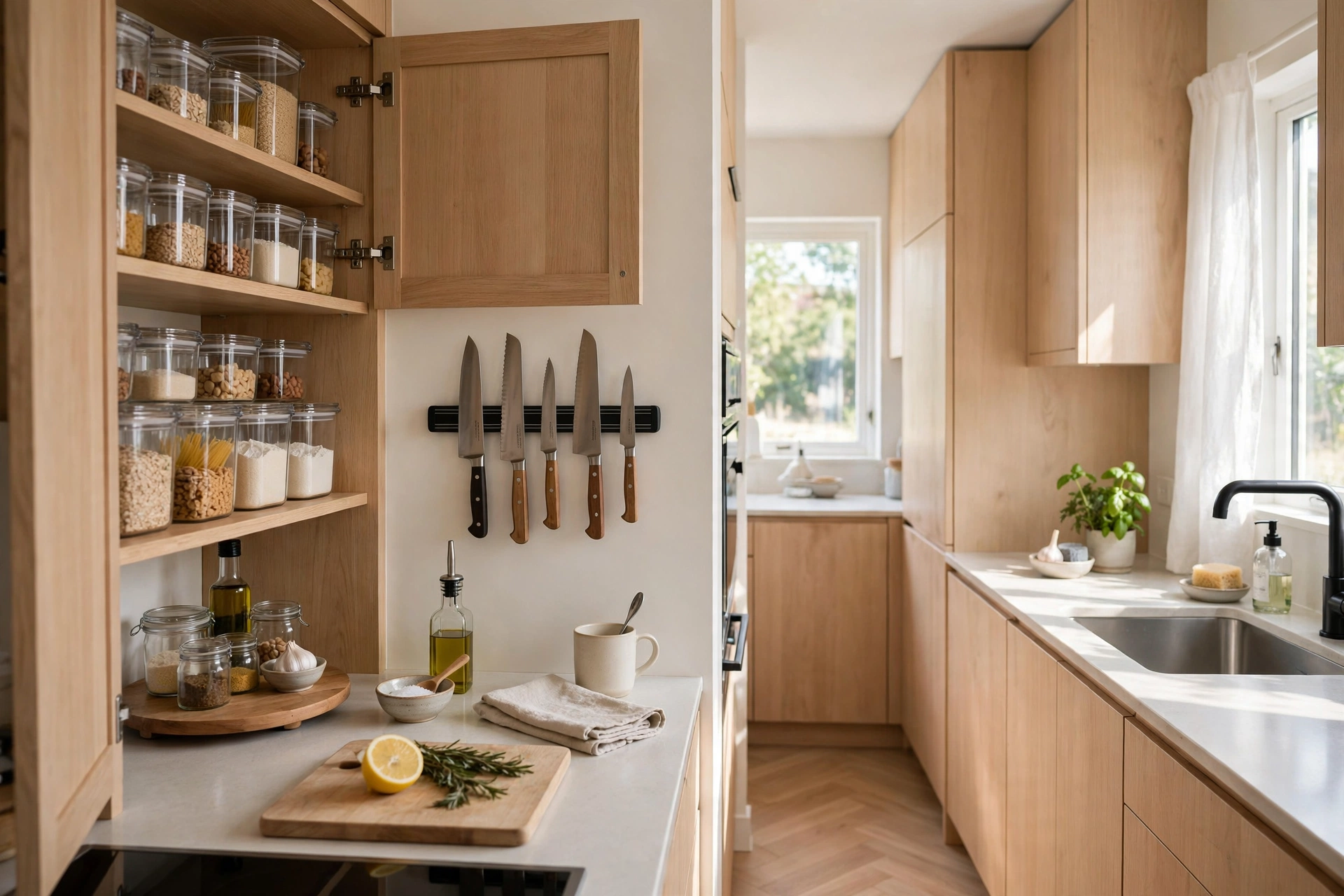
A small kitchen is not a failed kitchen. Some of the best home cooks in the world work in galley kitchens barely wider than their wingspan — because a compact kitchen, organized well, beats a sprawling chaotic one every time. Everything is within reach, every tool earns its place, and cooking becomes a flow instead of a treasure hunt. These small kitchen organization ideas will help you double your usable space without knocking down a single wall.
This guide covers the principles that make tiny kitchens work, zone-by-zone organization for cabinets, drawers, counters, and pantries, the vertical and hidden spaces most people waste, the products actually worth buying (and the gimmicks to skip), and a weekend action plan that transforms your kitchen in two days. Whether you rent or own, cook daily or reheat occasionally, your small kitchen is about to feel twice as big.
The Small-Kitchen Mindset: Edit First, Organize Second
Here is the uncomfortable truth about small kitchens: no organizing product fixes too much stuff. Before buying a single bin or shelf, edit ruthlessly. Pull out every duplicate, every gadget you have not touched in a year, every chipped mug, every “just in case” appliance. Small kitchens run on the one-in-one-out principle — if something new comes in, something old goes out. Sell the good duplicates with our guide to how to sell unused items around your house fast, donate the rest, and watch your cabinets breathe. Our room-by-room decluttering guide for beginners has the full method, but the kitchen version is simple: keep what you use weekly, store what you use monthly elsewhere, and release the rest.
Be especially honest about unitaskers — tools that do one job. The avocado slicer, the banana hanger, the strawberry huller: each one consumes precious space for a task a knife already handles. Professional chefs work with shockingly few tools because skill replaces gadgets. You do not need to be a chef, but every unitasker you release frees space for something you actually reach for daily.
After editing, count what remains by category. This inventory is your organizing blueprint: it tells you how much storage each category truly needs, which prevents the classic mistake of buying organizers before knowing what they must hold. Measure your cabinets, drawers, and pantry too — organizer shopping without measurements is how people end up with beautiful bins that do not fit.
Small Kitchen Organization Ideas: The Zone System
The single most transformative concept for any kitchen is zones: group everything by task, and store each group where the task happens. In a small kitchen, zones prevent the cross-kitchen marathon that makes cooking feel chaotic.
The cooking zone (around the stove): oils, salts, spices, spatulas, tongs, and the pans you use most — all within one step of the burner. A small turntable (lazy Susan) in the cabinet beside the stove keeps oils and sauces findable. The prep zone (the largest clear counter): cutting boards, knives, mixing bowls, and a compost or trash bin within reach. If counter space is minimal, a cutting board that fits over the sink instantly creates more prep area.
The cleaning zone (around the sink): dish soap, sponge, dish towels, and the drying rack. Keep only daily dish soap here — the backup bottles live elsewhere. The food storage zone (pantry area): group by meal logic rather than package shape — breakfast items together, baking together, snacks together. The serving zone (near the table or dining area): everyday dishes, glasses, and placemats where they travel the shortest distance.
When every item lives in its task zone, two things happen: cooking gets faster because nothing requires a search, and putting away groceries and clean dishes gets faster because every item has an obvious home. For the deeper dive on zone logic, our complete kitchen organization guide expands this system to kitchens of every size.
Cabinets: Double Every Shelf
Kitchen cabinets waste enormous vertical space — the gap between shelves is designed for the tallest possible item, which means most shelves hold one layer with inches of air above. Shelf risers (wire or bamboo platforms) instantly create two levels where there was one, doubling plate, bowl, and mug storage. They are cheap, require no installation, and work in every cabinet.
Use the insides of cabinet doors: adhesive or screw-mounted racks hold spices, wraps, and cleaning supplies on otherwise dead space. Under-shelf baskets hook onto existing shelves to create bonus storage for mugs or small items. For deep lower cabinets — the black holes of small kitchens — pull-out drawers or sliding baskets are transformative; they bring the back of the cabinet to you instead of requiring spelunking.
Store by frequency: daily items at eye and hand level, weekly items one reach up or down, and rarely-used items (the holiday platter, the bread maker) in the highest, deepest spots — or out of the kitchen entirely. The prime real estate rule is absolute in small kitchens: if you use it daily, it lives in the golden zone between your shoulders and knees. Everything else yields.
Drawers: Every Inch Assigned
Drawers fail without dividers — it is that simple. An undivided drawer becomes a junk drawer within weeks; a divided drawer stays organized for years. Adjustable bamboo or plastic dividers cost little and conform to any drawer. Assign every section: cooking utensils, serving utensils, wraps and bags, junk essentials (yes, one small organized junk section is allowed — batteries, tape, the thermometer).
File knives vertically in an in-drawer knife block rather than a countertop block — this frees an entire counter zone and is safer. Use the narrow gap beside the stove or fridge if you have one: slim rolling carts fit in 6-inch gaps and hold spices, oils, or cleaning supplies. Deep drawers benefit from two-tier inserts that stack shallow storage above deep storage.
The golden rule of drawers: if you have to move three things to reach one thing, the layout is wrong. Rearrange until the daily items are on top and grabbable. This one test, applied drawer by drawer, fixes most small-kitchen frustration.
Counters: Clear to Breathe
Counter space is the scarcest resource in a small kitchen, so defend it ruthlessly. The rule: only daily-use items earn counter space. For most households, that means the coffee maker (if truly daily), a knife block or magnetic strip alternative, a cutting board, and perhaps a utensil crock. Everything else — the stand mixer, the toaster, the blender — lives in a cabinet or on an appliance garage shelf.
Go vertical on the walls instead: a magnetic knife strip frees a drawer and a counter zone simultaneously; wall-mounted rails with hooks hold utensils, mugs, and small pans; a pegboard (painted to match your kitchen) creates customizable vertical storage that looks intentional, not improvised. These wall solutions are renter-friendly with adhesive or minimal-hole mounting — see our smart apartment hacks for renters for damage-free installation tricks.
Create landing zones: one clear stretch of counter, even just 18 inches, designated as the permanent “working” space that never collects clutter. Protect it like a runway. When counters stay clear, the whole kitchen feels twice as large — visual space is psychological space, a principle our small space living ideas explores throughout the home.
The Pantry: Small Space, Big System
Whether your “pantry” is a full closet or a single cabinet, the system is the same: decant, label, zone, and face forward. Decanting dry goods (flour, rice, pasta, snacks) into clear airtight containers does three things: it keeps food fresher, it makes inventory visible at a glance, and uniform containers look dramatically tidier than a chaos of bags and boxes. Decanting is also the perfect moment to check what you are actually eating — our guide to reading nutrition labels like a pro helps you spot the keepers. You do not need matching designer canisters — uniform sizes matter more than matching brands.
Zone the pantry by use: breakfast, cooking staples, baking, snacks, backstock. Use turntables for deep shelves (oils, vinegars, condiments), tiered risers for cans so labels are visible, and door-mounted racks for spices and small packets. Label everything — labels are what keep a shared household’s pantry working, because everyone can put things back correctly.
Maintain with the “shop your pantry first” habit: before grocery shopping, scan the pantry and plan meals around what needs using. This reduces food waste, saves money, and prevents the duplicate-buying that clutters small pantries. Our meal planning guide for saving money turns this habit into a full weekly system, and the waste-reduction angle pairs with how to reduce food waste at home.
Hidden and Wasted Spaces Worth Claiming
Small kitchens hide bonus storage in plain sight. Above the cabinets: the gap between cabinet tops and ceiling fits attractive baskets for rarely-used items — keep it tidy and it looks styled, not stuffed. Above the fridge: a deep, awkward space perfect for a bin of seldom-used appliances or bulk paper goods.
The toe-kick zone: the recessed space under lower cabinets can hold shallow drawers for baking sheets and platters — kits exist, or a handyperson can build them. Side of the fridge: magnetic shelves and racks turn dead space into spice and wrap storage. Inside cabinet doors: as mentioned, but also consider the pantry door and the under-sink doors for cleaning supplies.
Windowsill and wall ends: a narrow wall at the kitchen’s end fits a slim shelf for cookbooks or a mounted paper towel holder. Ceiling: a hanging pot rack frees an entire cabinet — but only if you cook with those pots regularly; otherwise it becomes dusty decor. Every claimed space should pass the test: does this make daily cooking easier? If yes, claim it. If it just stores more rarely-used stuff, skip it.
Products Worth Buying (and Gimmicks to Skip)
Worth every penny: shelf risers, turntables (at least two — under-sink and pantry), drawer dividers, under-shelf baskets, an over-sink cutting board or dish rack, and airtight containers in two or three uniform sizes. These are the workhorses; they solve real problems in every small kitchen.
Situationally useful: pull-out cabinet drawers (excellent but pricier — prioritize the worst deep cabinet first), magnetic wall strips, over-the-door pantry racks, and a slim rolling gap cart. Buy these for specific problems you have identified, not speculatively.
Skip: single-purpose organizers that only fit one brand’s containers, anything you have not measured for, decorative storage that holds less than the ugly version, and bulk “kitchen organization sets” — they bundle pieces you need with pieces you do not, and the per-piece cost is rarely a deal. Measure first, buy second, and only for the inventory you counted in step one. Restraint here is also thrift: the money you do not spend on gimmicks stays in the fund our 50 simple ways to save money every month helps you build.
Small Kitchen Organization Ideas: The Weekend Action Plan
Saturday morning: empty every cabinet and drawer onto the table (yes, all of it). Clean the empty spaces. Sort into keep, relocate, donate — being ruthless about duplicates and unitaskers. Saturday afternoon: define your zones on paper, assign every kept item to a zone, and install shelf risers, dividers, and door racks. Put everything back by zone.
Sunday: tackle the pantry with the decant-label-zone system, mount wall storage (knife strip, rails, hooks), claim one hidden space, and clear the counters to daily-use-only. Sunday evening: cook a simple meal in the new kitchen and notice the difference — that first flow-state dinner is the reward.
Ongoing: the one-in-one-out rule, a two-minute counter reset after cooking, and a monthly five-minute audit of the junk section before it metastasizes. Fold kitchen upkeep into the 15-minute daily cleaning routine and the system maintains itself.
Final Thoughts
These small kitchen organization ideas share one philosophy: a small kitchen does not need more storage products — it needs fewer things, each with a zone-designed home, using vertical and hidden space that was always there. Edit ruthlessly, zone by task, double your shelves, divide your drawers, clear your counters, and systematize the pantry.
Give it one weekend. By Sunday evening you will be cooking in a kitchen that feels twice as large — not because you added space, but because you finally started using all of the space you had.










