
Every decluttering journey starts the same way: standing in a messy room, overwhelmed, with no idea where to begin. If you want to learn how to declutter your home without burning out by noon on day one, this room-by-room guide is for you. Instead of vague advice to “just get rid of stuff,” you will get a concrete order of operations, what to tackle in each room, and the mindset shifts that make the results stick.
We will start with the psychology of why decluttering feels hard, then walk through every major room — kitchen, living room, bedrooms, bathrooms, closets, office, and garage — with specific keep-toss-donate decisions for each. By the end, you will have a realistic plan you can execute one weekend at a time.
Why Learning How to Declutter Your Home Feels So Hard
Clutter is rarely just about stuff. Researchers who study the psychology of possessions find that we resist decluttering for predictable reasons: the endowment effect (we overvalue what we own), loss aversion (giving away feels like losing), the sunk-cost fallacy (“but I paid $80 for this”), and aspirational identity (the bread maker represents the person we meant to become).
Knowing this helps because you can name the feeling when it hits. Holding the expensive-but-unworn jacket? That is sunk cost talking — the money is gone whether the jacket stays or goes. Keeping the guitar you never play? Aspirational identity — you can honor the aspiration without storing the instrument.
The second reason decluttering feels hard is decision fatigue. Every item demands a micro-decision, and after 200 of them your brain quits. The room-by-room method below manages this by batching similar decisions together and by giving you clear rules — so most items sort themselves. Pair the physical work with the digital equivalent from how to declutter your digital life in one weekend for a whole-life reset.
The Ground Rules (Read Before You Touch Anything)
Rule 1: Work in this order — easiest wins first. Start with the bathroom or laundry room, not the garage or sentimental boxes. Early wins build momentum; starting with the hardest category drains it.
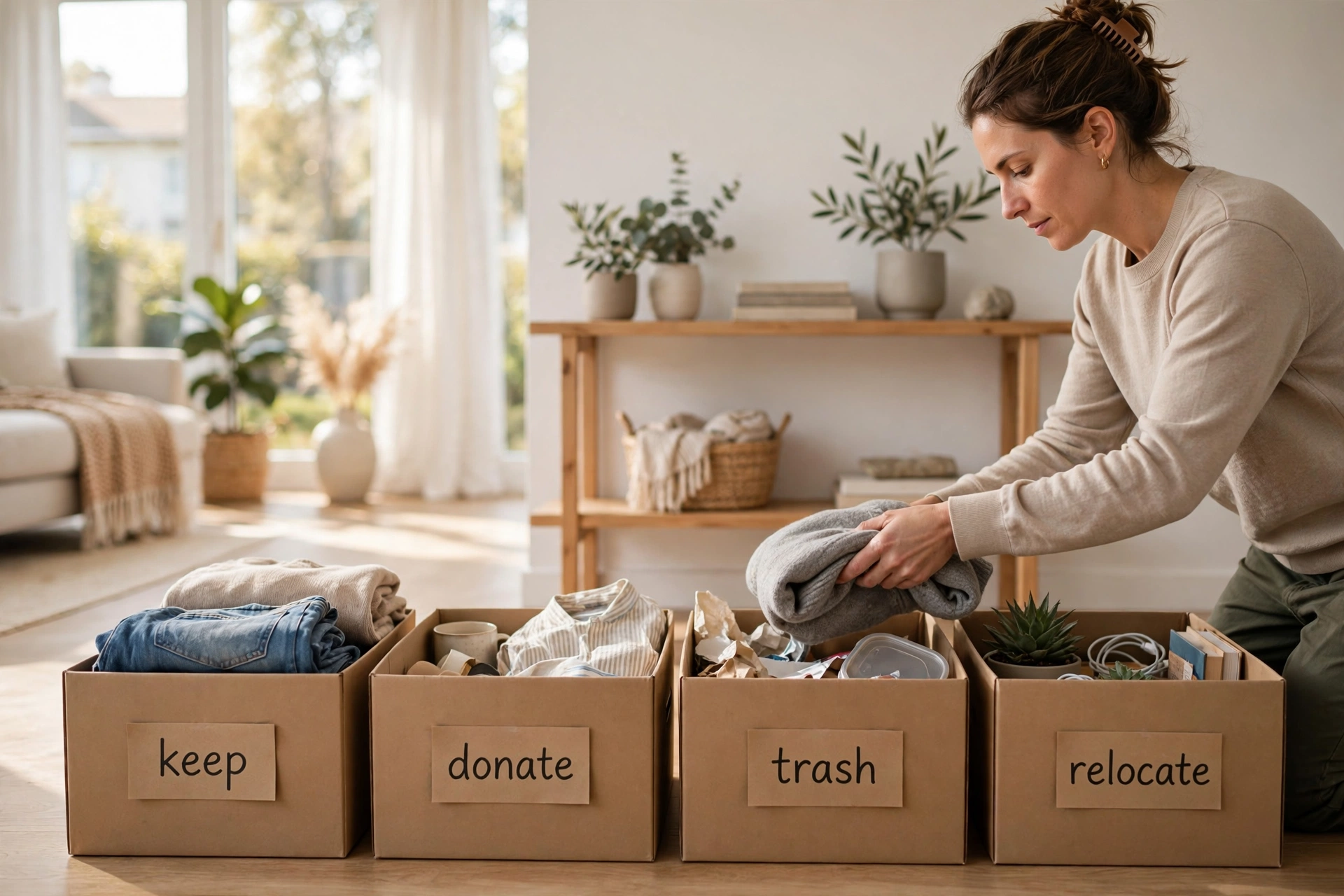
Rule 2: Four boxes, always. Every session uses four containers: Keep, Donate/Sell, Trash/Recycle, Relocate (belongs in another room). No “maybe” pile — maybes are how clutter survives.
Rule 3: One room, one session. Do not start the bedroom while the kitchen is mid-sort. Finish a defined zone completely — including taking donations to the car — before starting the next.
Rule 4: Time-box it. 2–3 hour sessions max. Marathon decluttering ends in exhaustion and half-sorted piles that become new clutter. The 10-minute daily tidy keeps things maintained between sessions.
Rule 5: The one-year test (with exceptions). Haven’t used it in a year? It goes — except for true seasonal items, sentimental keepsakes (limited to one box), and emergency supplies. Be honest about what “seasonal” means: the fondue set unused for six years is not seasonal, it is stored guilt.
Rule 6: Declutter before you organize. Buying organizers for clutter just creates organized clutter. Purge first, then contain what remains. Our KonMari method guide for real life offers a complementary category-based approach if you prefer decluttering by item type instead of by room.
Room 1: The Bathroom (Your Warm-Up Win)
Start here because decisions are easy — nobody is emotionally attached to expired sunscreen. Clear every surface, then go cabinet by cabinet:
- Toss: expired medications (check dates — take old meds to pharmacy take-back programs), dried-out makeup and nail polish, stretched-out hair ties, hotel toiletries you will never use, duplicate tools.
- Donate: unopened toiletries and sealed products to shelters.
- Keep, but corral: daily items get one tray or caddy; everything else lives behind closed doors. Counter clutter is visual noise you see every morning.
Wipe shelves as you go — you will finish in under an hour with a visibly transformed room. That dopamine hit powers the next room. For the deep-clean that follows the purge, see how to deep clean a bathroom like a pro.
Room 2: The Kitchen (Highest Impact)
Kitchens accumulate the most “someday” items in the house. Work zone by zone: counters, then one cabinet or drawer at a time.
- Counters: the goal is clear counters with only daily-use items (coffee maker, knife block). Everything else lives in cabinets. Clear counters make a kitchen feel twice as big and cleaning takes minutes.
- Utensil drawers: keep one of each core tool; toss the melon baller, the avocado slicer, and the third potato masher. If you have not reached for it in a year, donate it.
- Cabinets: match every container to a lid — lidless orphans go. Chipped mugs, stained plastic, and novelty glasses multiply silently; keep the best 8–10 of each and release the rest.
- Small appliances: the true test — have you used it in the last 12 months? Bread makers, juicers, and sandwich presses are the usual suspects. Keep the 2–3 you actually use; donate the museum pieces.
- Pantry: toss expired items, consolidate half-empty boxes, and group by category. An organized pantry is the foundation of meal planning to save money — you cannot plan around food you cannot see.
For lasting kitchen order after the purge, our guide to organizing your kitchen for stress-free cooking builds the zone system that keeps it this way.
Room 3: The Living Room (Visual Calm)
Living rooms suffer from surface creep — every flat surface slowly collects stuff. Reset them completely: remove everything from shelves, tables, and the entertainment center, then only return what earns its place.
- Media: DVDs, games, and remotes for devices you no longer own — donate or recycle. Digitize what you can.
- Decor: keep pieces you genuinely love; box the “it was a gift” items. One meaningful object beats five obligatory ones.
- Paper: magazines, catalogs, old mail — recycle ruthlessly. Go paperless on bills and catalogs to stop the inflow.
- Kid and pet zones: contain toys to one basket or area; rotate rather than display everything. Fewer visible toys = calmer room and more played-with toys.
The living room test: sit on the couch and look around. Every visible item should be something you use, love, or find beautiful. Everything else is visual static. This principle extends beautifully to small space living ideas — in compact homes, every visible item matters doubly.
Room 4: Bedrooms and Closets (The Deep Work)
Bedrooms hold the most emotionally loaded clutter — clothes tied to old identities, gifts, memories. Go slowly and use the full system in organize your closet once and for all: 9 steps for the wardrobe itself. The highlights:
- Clothes: if it does not fit, flatter, or get worn — out. “Someday” clothes (when I lose weight, when it comes back in style) are the biggest closet clog. Keep a capsule of what you actually wear.
- Nightstands: lamp, book, water — that is the ideal. Everything else migrates elsewhere.
- Under-bed: dust magnet and clutter cache. If you must store here, use lidded containers with labels, not loose piles.
- Sentimental items: limit to one memory box per person. Photograph bulky sentimental items (kids’ artwork, trophies) then release the originals — the memory lives in the photo, not the storage bin.
Bedrooms should feel like rest, not storage. And since you are here: a decluttered bedroom is the foundation of creating a relaxing bedroom for better sleep and the boutique-hotel bedroom feel — calm rooms genuinely rest you better.
Room 5: The Home Office and Paper (The Dreaded One)
Paper clutter is uniquely stressful because every sheet might be “important.” Defuse it with a simple triage: Action (needs doing — one tray), File (reference — one drawer or digital scan), Recycle (everything else). Be aggressive: most paper is reference you will never consult or action long overdue.
- Go digital: scan keep-worthy documents, then shred the originals (keep physical copies only of what legally requires them: property deeds, birth certificates, etc.).
- Cables and tech: the drawer of mystery cables — keep one of each common type, recycle the rest at e-waste programs. Label what you keep.
- Desk surface: clear it fully, then return only daily tools. A clear desk measurably reduces the mental load documented in home office desk setup essentials.
- Stop the inflow: unsubscribe from catalogs and junk mail, go paperless on statements, and put a recycling bin by the door for immediate mail triage.
Room 6: Kids’ Rooms, Laundry, and Utility Spaces
Kids’ rooms: involve the kids — decluttering is a life skill, and our guide to teaching kids about money at every age frames letting-go as part of valuing what you keep. Use the toy rotation: box half the toys, swap monthly — it feels like new toys for free. Broken toys, outgrown clothes, and Happy Meal trinkets go without ceremony.
Laundry room: half-empty detergent bottles consolidate; single socks without partners for 6+ months get retired; lint, dryer sheets, and long-dead stain removers get tossed. Then learn laundry basics so the room stays functional, not just empty.
Garage/storage: save for last — it is the final boss. Sort by zone (tools, sports, holiday, automotive), toss the dried paint, dead batteries, and mystery hardware, and be ruthless with “project” items whose projects will never happen. If you have not touched the treadmill in two years, selling unused items around the house turns it into cash instead of guilt.
How to Declutter Your Home and Keep It That Way: Maintenance
Decluttering without maintenance is mowing without edging — it grows back. Install these habits:
- One in, one out. Every new item entering the house replaces one leaving. New shirt? An old one gets donated. This single rule prevents 80% of re-clutter.
- The 10-minute nightly reset. The 15-minute daily cleaning routine (or its 10-minute cousin) returns every room to baseline before bed. Waking to order changes mornings completely.
- Quarterly mini-purges. 30 minutes per room, four times a year, catches accumulation before it becomes a project.
- Guard the gates. Most clutter enters via shopping, freebies, and gifts. Apply the 30-day rule to non-essential purchases, decline freebies reflexively, and suggest consumable or experience gifts to family.
- Seasonal clothing swaps. Store off-season clothes properly (see storing seasonal clothes the smart way) so closets only hold what is wearable now.
Decluttering With a Partner or Family (Without Fights)
Solo decluttering is straightforward; shared homes add diplomacy. The golden rule: only declutter your own stuff — plus clearly shared household items by agreement. Touching your partner’s belongings uninvited is how decluttering starts arguments instead of ending clutter.
For shared spaces, agree on the standard together: what does “done” look like for the living room? Photograph the agreed state so everyone knows the target. For kids, make it a game with categories and a timer — and let them control their own keep-toss decisions within reason; forced purging teaches resentment, not minimalism.
Schedule joint sessions for shared zones (garage, kitchen) and solo sessions for personal zones (closets, desks). And celebrate together when a room is done — order takeout, enjoy the clear counters. Shared wins build the household culture where clutter simply does not accumulate, because everyone owns the standard.
Remember: the goal was never perfection — it is a home that supports your life instead of draining it. Progress, not perfection, one room and one box at a time.
Final Thoughts
Learning how to declutter your home is not about achieving a magazine cover — it is about removing the friction between you and the life you want in your space. Start with the bathroom this weekend, follow the four-box system room by room, and let the early wins carry you. Most beginners finish the whole house in 4–6 weekends of short sessions.
The real prize is not the empty shelves; it is what fills the space instead — calmer mornings, easier cleaning, rooms that rest you rather than nag you, and the quiet confidence of a home fully under your control. Pick your first room today, grab four boxes, and start. Future you, walking into a calm clear kitchen on a Monday morning, says thanks.










