
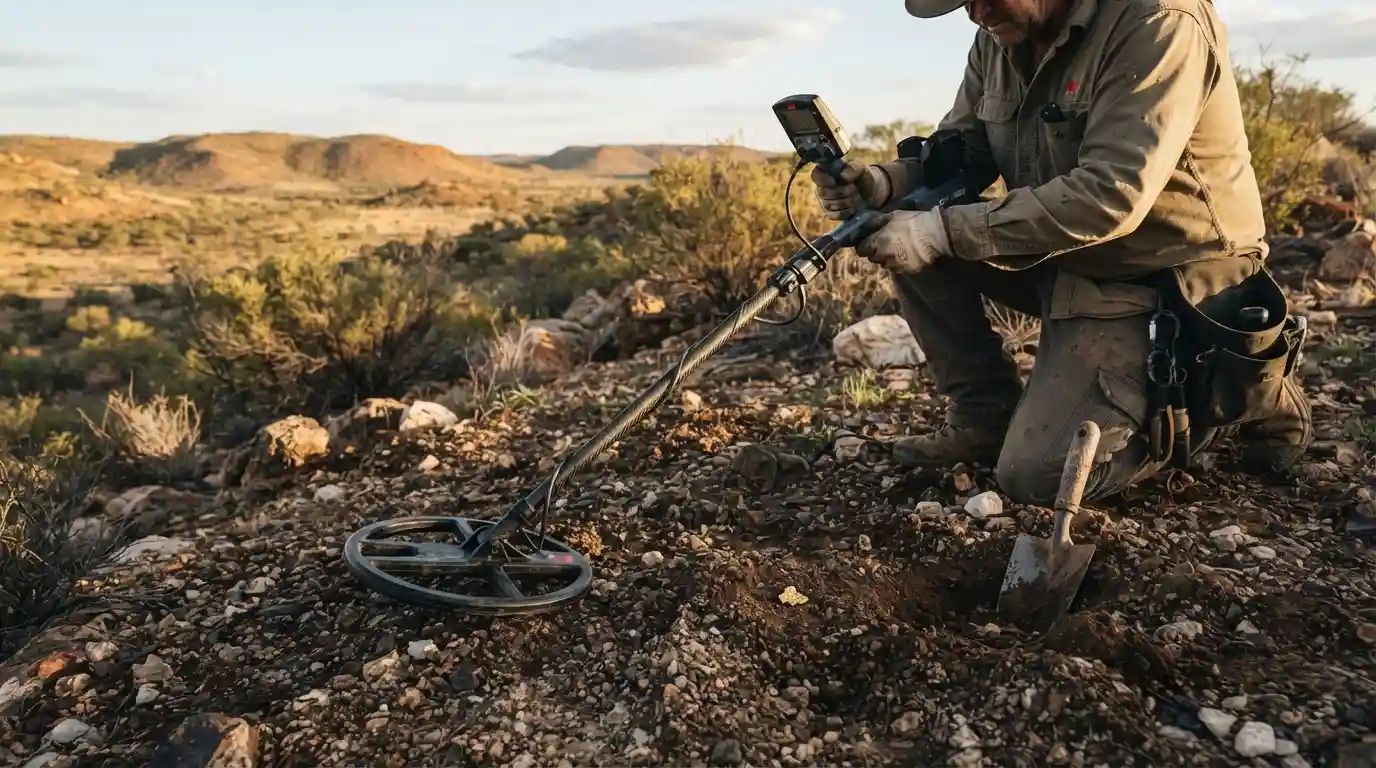
For anyone interested in gold metal detection, the real challenge is not simply finding metal. Gold can occur as tiny flakes, small nuggets, jewelry, specimens, or larger pieces buried in soil with significant mineralization. That makes detector selection, settings, technique, and understanding of ground conditions important parts of the exploration process.
Modern exploration also overlaps with broader outdoor interests. People who enjoy hunting gear and outdoor equipment, for example, may already understand why choosing equipment for a specific environment matters. Metal detecting follows a similar principle: the right technology should match the terrain, target, and objective.
How Modern Metal Detection Works
At its core, a metal detector uses an electromagnetic field to interact with conductive objects below or near the surface. The search coil transmits a signal into the ground. When that signal encounters metal, electrical currents are generated within the target, producing a secondary response that the detector’s electronics can measure.
The control system then converts that response into information that the operator can interpret. Depending on the detector, this may include audio tones, target identification numbers, depth information, visual indicators, or combinations of these signals.
This basic principle has remained consistent while the technology surrounding it has become considerably more advanced. Developments in modern technology and innovation, signal processing, computing, and sensor design have all contributed to increasingly sophisticated detection equipment.
Why Gold Is a Challenging Detection Target
Gold presents a unique challenge because prospecting targets are often small. A detector designed primarily for large coins or conventional relics may not provide the sensitivity needed for tiny gold pieces, particularly when the surrounding soil produces strong electromagnetic responses of its own.
Ground mineralization is one of the biggest factors. Iron-rich or otherwise highly mineralized soil can generate signals that compete with the much weaker response from a small nugget. The result can be false signals, unstable operation, or reduced sensitivity.
This is why serious prospecting requires more than simply purchasing a detector advertised for gold. Operators need to understand how the machine behaves in the specific environment where they intend to search.
VLF Technology and Gold Prospecting
Very Low Frequency, or VLF, detectors are widely used for metal detection. They continuously transmit electromagnetic signals and analyze the response from nearby targets. Many VLF machines provide target identification, discrimination, sensitivity adjustments, and ground-balance controls.
One major advantage of high-frequency VLF technology is sensitivity to smaller targets. This can make it useful when searching for small gold nuggets or other relatively low-conductivity targets in ground that the detector can stabilize effectively.
The tradeoff is that mineralized ground can make VLF operation more difficult. Increasing sensitivity may improve the response to a small target, but it can also increase the detector’s response to mineralized soil and hot rocks.
The broader development of information technology illustrates the same general trend seen in modern detectors: better processing allows equipment to extract useful information from increasingly complicated signals.
Pulse Induction Technology
Pulse Induction, commonly called PI, takes a different approach. Instead of continuously transmitting a conventional signal, a PI detector sends short electrical pulses into the ground and measures what happens after each pulse.
PI technology is particularly useful in highly mineralized environments because its signal-processing approach can reduce the influence of difficult ground conditions. This makes pulse-induction detectors popular among prospectors working in challenging goldfields.
PI systems can also be useful when searching for deeper or larger targets. However, technology should always be matched to the specific objective rather than selected simply because one detector type sounds more advanced.
Multi-Frequency Detection
Modern multi-frequency detectors provide another option. Rather than relying on a single operating frequency, these systems can use multiple frequencies to gather additional information about targets and ground conditions.
Multi-frequency technology can be particularly useful for explorers who want a versatile detector capable of handling different types of terrain and targets. It can also provide useful flexibility when moving between general-purpose detecting and more specialized searches.
The rapid evolution of detection systems reflects the broader movement toward smarter equipment. Similar developments can be seen across modern hardware technology, where sensors, processors, and user interfaces increasingly work together rather than functioning as isolated components.
Ground Balance: One of the Most Important Settings
Ground balance helps a detector distinguish changes caused by naturally occurring minerals in the soil from responses caused by actual metal targets.
This becomes especially important in gold prospecting because gold-bearing regions can contain strongly mineralized soil. Without appropriate ground handling, the detector may produce excessive noise or unstable responses.
Depending on the model, ground balance may be fixed, manually adjusted, automatically calibrated, or continuously tracked. Learning how the chosen detector handles ground conditions is therefore an essential part of becoming a more effective operator.
Target Identification and Discrimination
Target identification can help an operator estimate what type of object may be beneath the coil. Many modern detectors use numerical target IDs, audio tones, visual indicators, or combinations of these features.
Discrimination settings can also help reduce attention given to unwanted targets such as certain iron objects. However, gold prospectors need to be careful with aggressive discrimination because small gold targets can produce responses that overlap with other low-conductivity materials.
In practical exploration, target ID should be treated as useful information rather than an absolute guarantee. Soil conditions, target orientation, depth, size, and detector settings can all influence the response.
Search Coil Selection Matters
The search coil is one of the most important physical components of a metal detector. Coil size and design influence sensitivity, coverage, separation, and practical handling.
A smaller coil can be useful in areas with vegetation, rocks, tight spaces, or significant target clutter. A larger coil may cover more ground and potentially provide advantages when searching for larger or deeper targets in suitable soil.
There is no universal coil configuration that works perfectly everywhere. Explorers should consider the terrain and target before choosing the coil that will accompany the detector.
Frequency and Small Gold
Operating frequency is another important consideration when searching for gold. Higher-frequency VLF detectors can be particularly sensitive to small targets, making them attractive for fine-gold and small-nugget hunting.
Lower-frequency systems can offer different advantages, particularly when larger targets and greater penetration are priorities. The important point is that frequency is part of a larger system rather than a standalone measurement of detector quality.
Understanding technical specifications can be easier when you have a basic grasp of how modern devices process information. The broader technology trends shaping today’s equipment provide useful context for how sensors and electronic processing continue to improve.
Choosing a Detector for Different Exploration Environments
The ideal detector depends heavily on where and how it will be used.
Dry, Mild Soil
In relatively mild ground, a sensitive VLF detector may provide an effective combination of target response, discrimination, and ease of use. Beginners can often benefit from a machine that provides clear feedback and straightforward controls.
Highly Mineralized Ground
When mineralization becomes severe, ground handling becomes a major priority. PI technology can be advantageous because it is designed to operate more effectively in difficult mineralized environments.
Riverbeds and Creek Areas
Creek beds can present unique opportunities because natural erosion and water movement can concentrate heavy materials. They can also create difficult terrain where compact equipment is easier to maneuver.
Outdoor explorers interested in natural environments may also enjoy destinations such as nature-focused travel locations, although detecting activities should always comply with local land-access rules.
Remote Exploration
When operating far from facilities, equipment weight, battery life, weather resistance, spare batteries, recovery tools, and transportation become increasingly important. The detector itself is only one part of a successful field setup.
Modern Detection Is About More Than Depth
Depth is one of the most frequently discussed specifications in metal detecting, but it should not be the only consideration. Real-world detection depth varies according to target size, target composition, orientation, soil mineralization, coil configuration, detector settings, and environmental interference.
A detector that provides excellent stability and sensitivity to small targets can be more useful in some environments than a machine marketed primarily around maximum theoretical depth.
Experienced operators therefore evaluate several characteristics together: sensitivity, ground handling, target response, recovery speed, discrimination, coil options, ergonomics, battery performance, and environmental durability.
Technology Meets Exploration
Metal detecting has become part of a wider outdoor exploration culture. The activity combines technology, observation, patience, geography, history, and fieldcraft.
This is particularly clear when detecting is incorporated into broader travel and outdoor itineraries. Travelers exploring destinations such as Upstate New York, for example, may encounter landscapes where geology, history, and outdoor recreation overlap. Detecting itself, however, should only be undertaken where local regulations and landowner permissions allow it.
Likewise, those interested in New York travel and exploration should distinguish between simply visiting an area and conducting a regulated activity such as metal detecting.
Responsible Metal Detecting
Modern exploration should always include responsible recovery practices. Before detecting, determine whether the land is privately owned, publicly managed, protected, or subject to special restrictions.
Permission should be obtained where necessary, and protected archaeological or historical sites should never be treated like unrestricted recreational detecting areas.
Responsible detectorists also aim to minimize environmental disturbance. Recover targets carefully, refill holes, avoid unnecessary damage to vegetation, and remove modern trash when appropriate.
This approach is especially important when exploring popular outdoor destinations. Travel resources such as U.S. winter destinations and California road-trip destinations can inspire exploration, but recreational activities must always follow the rules established for the specific property.
Essential Equipment Beyond the Detector
A detector alone is rarely enough for a serious field session. Depending on the terrain and target, useful supporting equipment can include a pinpointer, digging tool, recovery pouch, gloves, spare batteries, headphones, protective equipment, water, navigation equipment, and appropriate outdoor clothing.
The same principle applies to other forms of outdoor recreation: equipment should support the environment rather than create unnecessary complications. Articles such as daring outdoor sports and activities demonstrate how different environments demand different preparation, although metal detecting has its own specific equipment requirements.
How Beginners Can Improve Their Detection Skills
New detectorists often focus heavily on equipment specifications. Learning the machine is just as important as buying it.
- Start with the manual: Understand every major control before heading into difficult terrain.
- Practice with known targets: Test coins, small metal objects, and representative targets above ground to understand their responses.
- Learn ground behavior: Pay attention to how soil changes affect the threshold and target response.
- Sweep consistently: Keep the coil at a relatively consistent height and move methodically.
- Investigate repeatable signals: A signal that behaves consistently from different directions deserves closer attention.
- Keep a field record: Recording settings, soil conditions, targets, and results can accelerate learning.
Patience is particularly important. Successful prospecting is not guaranteed simply because a detector has advanced electronics. Field knowledge and careful interpretation remain central to the process.
The Role of Precision Technology
The future of metal detection is likely to continue moving toward better signal processing, improved target characterization, lighter equipment, longer battery performance, and more intuitive interfaces.
Developments in precision manufacturing technology can also influence the physical construction of equipment, while advances in surface-protection technologies illustrate how specialized materials can improve durability in demanding environments.
Other technology sectors are experiencing similar movement toward compact, efficient, user-focused systems. The discussion surrounding modern business technology solutions reflects the broader transition toward intelligent tools that combine hardware, software, and data processing.
Gold Detection as a Modern Exploration Discipline
Today’s gold and metal detection landscape combines traditional field exploration with sophisticated electronic technology. VLF systems can provide sensitivity and useful target information, PI detectors can offer advantages in difficult mineralized ground, and multi-frequency systems can provide versatility across changing environments.
The most effective approach is not simply to search for the detector with the biggest advertised number. Instead, match the technology to the terrain, target size, mineralization, search objectives, and experience level.
For explorers, that combination of equipment knowledge and field awareness can turn metal detecting from a simple recreational activity into a structured exploration discipline. Whether the goal is finding small gold nuggets, investigating historic areas where permitted, or simply learning more about the ground beneath your feet, modern detection technology provides increasingly sophisticated tools for the job.
As technology continues to advance, the most valuable advantage will remain the same: understanding how to use the equipment correctly, interpreting its signals carefully, and exploring responsibly.










