
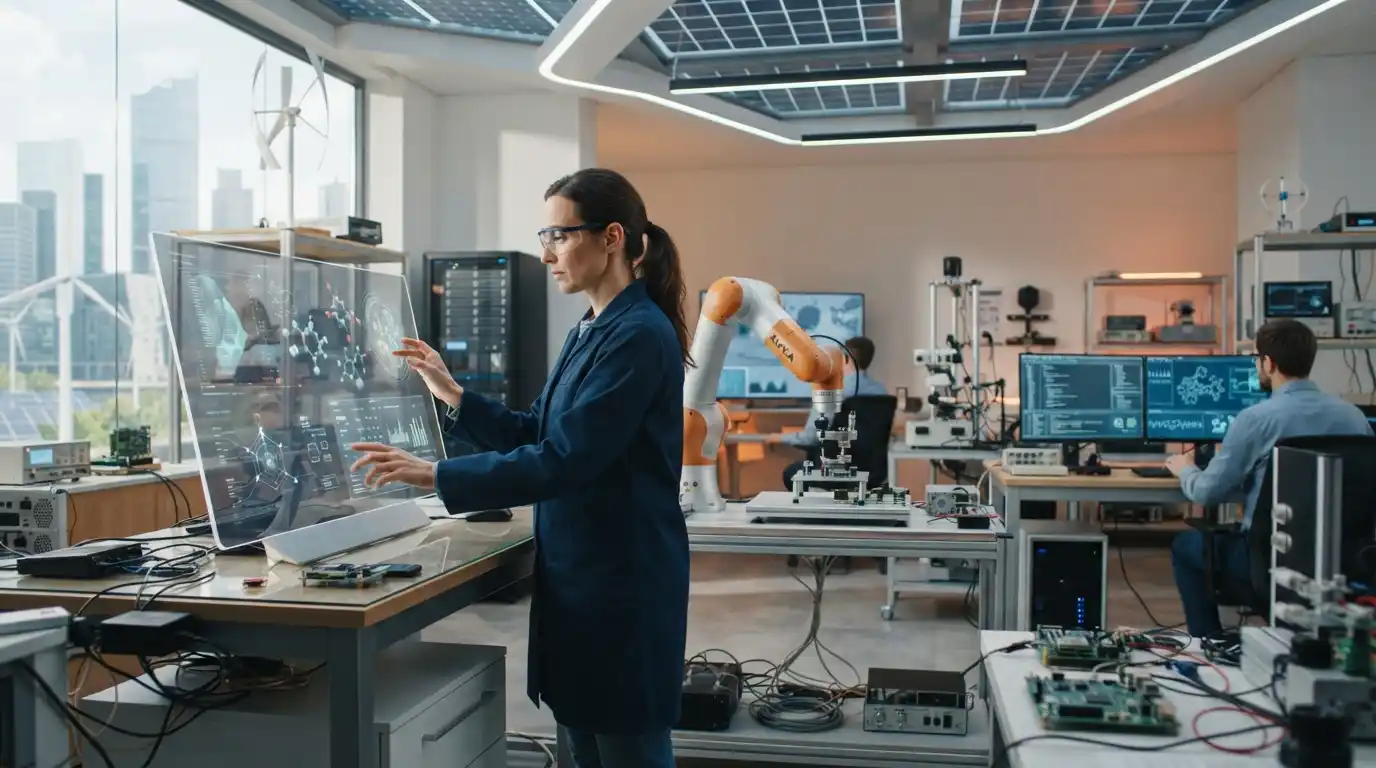
The important question is not whether technology is transforming modern life. It already is. The more useful question is how these developments are changing everyday experiences, where their greatest benefits are appearing, and what challenges society needs to address as adoption accelerates.
What Are Scientific Technologies?
Scientific technologies are practical applications of scientific knowledge, research, engineering, and experimentation. They turn discoveries and theoretical ideas into tools, systems, processes, and products that can solve real-world problems.
This broad category includes technologies based on computer science, physics, chemistry, biology, engineering, materials science, environmental research, and other scientific disciplines. Some are visible, such as smartphones, electric vehicles, medical devices, and industrial robots. Others operate behind the scenes through cloud infrastructure, algorithms, sensors, databases, and automated systems.
The rapid development of these technologies is also closely connected to broader information technology trends and the increasing digital transformation of businesses and public services.
Artificial Intelligence Is Changing How We Work
Artificial intelligence has become one of the most recognizable examples of scientific technology moving into everyday life. AI systems can analyze large amounts of information, recognize patterns, generate content, support decision-making, and automate repetitive tasks.
Businesses are using AI in customer service, marketing, cybersecurity, forecasting, research, logistics, and data analysis. Individuals encounter AI through search systems, recommendation engines, voice assistants, translation tools, navigation applications, and increasingly sophisticated productivity software.
AI does not necessarily eliminate the need for human expertise. In many applications, its greatest value comes from helping people process information faster and concentrate on tasks that require judgment, creativity, communication, and problem-solving.
The expansion of AI also contributes to wider digital transformation across industries, where organizations are combining automation, data, and connected technologies to redesign traditional workflows.
Healthcare Is Becoming More Data-Driven
Scientific advances are also changing healthcare. Modern medical systems increasingly rely on advanced imaging, laboratory technologies, digital records, remote monitoring, genetic research, robotics, and computational analysis.
These developments can help healthcare professionals detect conditions, evaluate patient information, plan treatments, and monitor health more efficiently. Wearable devices can also collect information about activity, sleep, heart rate, and other measurements, giving people new ways to understand aspects of their daily health.
Technology does not replace doctors or other healthcare professionals, but it can provide additional information and tools that support clinical decision-making. The continued development of healthcare technologies and medical roles illustrates how technological progress is also changing the skills required across the healthcare sector.
Robotics Is Moving Beyond Factories
Robotics was once strongly associated with manufacturing plants and industrial assembly lines. Today, robotic systems are being developed for warehouses, healthcare, agriculture, transportation, inspection, research, and other specialized environments.
Industrial robots can perform repetitive tasks with consistent precision, while newer autonomous systems can respond to changing environments using sensors, computer vision, and machine-learning techniques.
The growth of robotics is particularly important where tasks are repetitive, physically demanding, hazardous, or require extremely consistent movements. Human workers can then focus more heavily on supervision, maintenance, planning, quality control, and complex decision-making.
Robotics also intersects with advances in modern computing hardware, because increasingly capable machines require faster processors, better sensors, efficient data processing, and reliable connectivity.
Smart Devices Are Connecting the Physical World
The Internet of Things has created another major shift. Sensors and connected devices can collect information from physical environments and transmit it to software platforms for monitoring or analysis.
Smart thermostats, security systems, industrial sensors, fitness trackers, connected appliances, and vehicle systems are examples of this approach. Instead of operating as isolated objects, devices can communicate with digital systems and respond to changing conditions.
This connectivity can improve convenience and operational efficiency, but it also increases the importance of cybersecurity, privacy, device management, and reliable networks.
As more devices become connected, understanding how modern networks work becomes increasingly important for both organizations and consumers.
Renewable Energy Is Reshaping the Energy Landscape
Scientific research is also driving changes in energy production and storage. Solar power, wind energy, battery technologies, smart grids, and other energy systems are developing as societies look for ways to produce and manage energy more efficiently.
Advances in materials science and engineering can improve the performance of energy technologies, while better software can help manage electricity generation, storage, and consumption.
The transition toward more diversified energy systems is not simply a matter of replacing one technology with another. It involves infrastructure, storage capacity, grid management, manufacturing, transportation, economics, and long-term planning.
Advanced Materials Are Creating New Possibilities
Materials science is another area where scientific discoveries can have surprisingly broad effects. Researchers continue to develop materials with specialized properties such as greater strength, improved conductivity, resistance to heat, lighter weight, or enhanced durability.
These innovations can influence construction, transportation, electronics, manufacturing, medical equipment, and consumer products. Even technologies that appear ordinary can depend on years of scientific research into metals, polymers, ceramics, composites, coatings, and electronic materials.
The development of specialized industrial solutions can be seen in areas such as precision casting technology and advanced surface protection technologies.
Computing Power Is Accelerating Scientific Discovery
Scientific progress increasingly depends on computational power. Researchers can use advanced computers to simulate physical systems, analyze massive datasets, model biological processes, process images, and test complex scenarios.
This means computing is not simply a consumer technology. It has become an important research instrument across science and engineering.
As processors, graphics hardware, storage systems, and networking technologies improve, researchers can tackle problems that were previously too large or complicated to analyze efficiently.
The same hardware ecosystem supports everyday applications, including responsive device testing and the increasingly demanding applications used on modern computers.
Scientific Technology Is Transforming Business
Businesses are among the largest adopters of scientific and digital technologies. Automation, analytics, artificial intelligence, cloud platforms, connected devices, and advanced software can change how companies acquire customers, manage operations, deliver services, and evaluate performance.
Digital marketing provides a clear example. Businesses can now analyze customer behavior, measure campaign performance, personalize communications, and reach audiences across multiple digital channels.
Companies are increasingly focused on measurable outcomes, including the competitive advantages created through digital marketing and the return generated by digital marketing investments.
At a broader level, technology is influencing how companies scale. Research, automation, e-commerce, customer data, and digital infrastructure can allow organizations to expand their reach without relying entirely on traditional operating models.
This is reflected in discussions around scaling business services and e-commerce growth and scalability.
Technology Is Changing Transportation and Travel
Transportation has also benefited from scientific and engineering advances. Modern vehicles rely on increasingly sophisticated electronics, sensors, navigation systems, safety technologies, and software.
At the same time, digital platforms have changed how people plan journeys, compare destinations, reserve accommodations, navigate unfamiliar locations, and share travel experiences.
Travel technology can make trips easier to organize, while scientific advances in transportation can improve efficiency, safety, and accessibility.
For travelers interested in exploring destinations, resources covering world travel planning and destinations for trips with friends demonstrate how digital information has become part of the modern travel experience.
Scientific Technologies Are Improving Everyday Convenience
Not every technological revolution involves a dramatic invention. Many of the most meaningful changes happen gradually through improvements to ordinary activities.
People can communicate instantly across continents, access information from almost anywhere, manage finances online, use navigation systems, monitor household devices, collaborate remotely, and access digital entertainment from compact devices.
Even personal computing has become more accessible as operating systems and hardware have evolved. Guides covering computer features and everyday technology tips illustrate how software has become deeply integrated into routine activities.
The Role of Data in Scientific Progress
Data is one of the foundations behind many modern technologies. Scientific instruments, sensors, websites, mobile devices, businesses, and connected machines can generate enormous quantities of information.
The challenge is no longer simply collecting data. Organizations need reliable methods for storing, processing, interpreting, securing, and communicating it.
When data is combined with statistical analysis, machine learning, visualization, and domain expertise, it can help researchers and organizations identify patterns that would otherwise be difficult to see.
This data-driven environment is closely connected with the measurement and optimization of digital strategies used by modern organizations.
The Benefits Come With New Responsibilities
Scientific technology can create enormous opportunities, but technological progress is not automatically beneficial in every situation. The way a technology is designed, implemented, governed, and used can influence its consequences.
Privacy is one important consideration. Connected devices and digital services can process significant amounts of information, making responsible data management essential.
Cybersecurity is another concern. As more critical systems become digitally connected, organizations need stronger defenses against unauthorized access, disruption, and data loss.
There are also questions surrounding employment, digital inequality, environmental costs, algorithmic decision-making, and the responsible use of artificial intelligence. These issues require practical policies, technical safeguards, education, and informed public discussion.
Why Scientific Literacy Matters
As technology becomes more influential, scientific literacy becomes increasingly valuable. People do not need to become professional scientists to understand the basic principles behind technologies that affect their lives.
Understanding how data works, how algorithms make decisions, how networks connect devices, and how scientific evidence is evaluated can help people make better-informed choices.
Businesses also benefit from scientific and technological literacy because employees who understand digital systems can adapt more effectively as tools and processes evolve.
What the Future May Look Like
The next stage of technological development will likely involve greater integration rather than isolated breakthroughs. Artificial intelligence, robotics, biotechnology, advanced materials, cloud computing, sensors, and energy technologies can increasingly work together.
For example, an intelligent manufacturing system could combine sensors, robotics, machine learning, predictive maintenance, and advanced materials. A healthcare platform could combine wearable devices, medical imaging, computational analysis, and remote monitoring.
The most significant developments may therefore come from combinations of technologies rather than from a single invention.
How People and Businesses Can Prepare
Preparing for technological change does not mean adopting every new product or trend. A more practical approach is to understand the problem first and then determine whether technology can solve it effectively.
Individuals can focus on digital literacy, cybersecurity awareness, adaptable skills, and responsible use of emerging tools. Businesses can evaluate technologies based on measurable needs, security requirements, costs, scalability, and their potential effect on customers and employees.
Organizations exploring digital transformation can also examine areas such as advanced digital capabilities, business process optimization, and e-commerce agility.
Final Thoughts
Scientific technologies are revolutionizing modern life because they are changing not only the tools people use but also the systems behind healthcare, business, transportation, communication, energy, manufacturing, and research.
The real transformation comes from applying scientific knowledge to practical problems and continuously improving the technologies that support everyday life. Artificial intelligence, robotics, advanced computing, connected devices, renewable energy, biotechnology, and materials science are all contributing to this shift.
The future will bring additional opportunities, but responsible adoption will matter just as much as technical innovation. Understanding both the capabilities and limitations of emerging technologies can help individuals and organizations use scientific progress more effectively.
Rather than treating technological change as something distant or futuristic, it is more useful to recognize that it is already part of everyday life. The challenge now is to make that progress useful, secure, accessible, and responsible.










