
Most people stretch wrong. They bounce aggressively, yank cold muscles, hold their breath, and stretch for ten seconds while checking their phone — then wonder why they are still stiff and occasionally hurt themselves. Learning how to stretch properly is one of the highest-return skills in fitness: it keeps you supple, reduces injury risk, eases the stiffness of desk life, and honestly just feels wonderful when done right.
This beginners’ guide covers everything: the two types of stretching and when to use each, a complete full-body sequence with exact form cues, how long to hold each stretch, how to breathe, and the mistakes that turn stretching from helpful to harmful. No flexibility required to start — that is the whole point.
Why Stretching Matters More Than You Think
Stretching sits in an odd place in fitness culture: everyone knows they “should” do it, almost nobody does it well, and its benefits are simultaneously overstated by yoga influencers and understated by lifters who skip it entirely. Here is the balanced truth.
What stretching genuinely does: Regular stretching improves flexibility and range of motion — this is well established. Greater range of motion makes daily life easier (reaching, bending, twisting), improves exercise form (deeper squats, better posture), and reduces the stiffness that accumulates from sitting. For desk workers, targeted stretching of hip flexors, chest, and neck directly counteracts the postural damage of eight seated hours. Our desk stretch routine is built on exactly this.
What it does not do: Stretching before exercise does not reliably prevent injury the way people think (a proper dynamic warm-up does that job better). It does not “flush lactic acid” or significantly reduce next-day soreness. And extreme flexibility is not a health goal — hypermobility without strength can actually destabilize joints. The goal is functional suppleness, not circus contortion.
The real payoff is consistency over months. One stretching session feels nice for an hour. Three months of regular stretching changes how your body feels to live in — less morning stiffness, easier movement, fewer of those mysterious aches. Like exercise habits generally, the magic is in repetition, not intensity.
The Two Types of Stretching (and When to Use Each)
This distinction is the single most important thing in the article. Get it right and everything else follows.
Dynamic stretching: movement-based, for BEFORE activity. Dynamic stretches take joints through their range of motion with controlled movement — leg swings, arm circles, walking lunges, hip circles. They raise muscle temperature, lubricate joints, and prime the nervous system. This is what your pre-workout routine should contain. Rule: dynamic before exercise.
Static stretching: hold-based, for AFTER activity (or standalone). Static stretches involve holding a position for 20–60 seconds — the classic “stretch and hold.” They are best done when muscles are warm: after a workout, after a walk, or as a standalone evening routine. Rule: static after exercise, never on cold muscles.
Why does the order matter? Static stretching temporarily reduces muscle power output — studies show small but real decreases in strength and explosiveness for up to an hour after prolonged static stretching. That is the opposite of what you want before lifting or sprinting. After exercise, though, static stretching is perfect: muscles are warm, pliable, and receptive.
There is a third type worth knowing: PNF (proprioceptive neuromuscular facilitation) — contract-relax stretching, where you tense the muscle for 5–10 seconds before stretching deeper. It is highly effective but best learned with guidance; beginners should master basic static stretching first.
How to Stretch Properly for Beginners: Full-Body Sequence
Do this sequence after a workout or walk, or as a standalone 15-minute routine (warm up with 2–3 minutes of marching in place first). Hold each stretch 30 seconds per side, breathe deeply, and never force a position. You should feel a gentle pull — never sharp pain.
Neck and Shoulders
1. Neck side tilt. Sit or stand tall. Tilt your right ear toward your right shoulder until you feel a stretch along the left side of your neck. For a deeper stretch, gently rest your right hand on your head — do not pull, just let the weight add pressure. Hold 30 seconds, switch sides. This directly undoes the “tech neck” of screen life; pair it with our desk posture fixes for lasting relief.
2. Cross-body shoulder stretch. Bring your right arm across your chest, hooking it with your left hand just above the elbow. Keep the shoulder down (do not shrug). Hold 30 seconds per side. Desk workers live in internal shoulder rotation — this opens the back of the shoulder beautifully.
3. Chest doorway stretch. Stand in a doorway, forearms on the frame at 90 degrees, and lean gently forward until you feel your chest open. Hunched posture shortens the chest muscles over time; this is the antidote. Hold 30 seconds, and try three heights (low, middle, high) to hit different fibers.
Back and Spine
4. Cat-cow. On all fours, inhale as you drop your belly and lift your head (cow), exhale as you round your back and tuck your chin (cat). Move slowly with the breath for 60 seconds. This is dynamic, so it also works as a warm-up move — it mobilizes the entire spine and feels incredible after sitting.
5. Child’s pose. Kneel, sit your hips back toward your heels, and reach your arms forward on the floor, forehead down. Let your back round and breathe into it. Hold 60 seconds. This gently stretches the lats, shoulders, and lower back — the holy trinity of desk-worker tightness.
6. Supine spinal twist. Lie on your back, arms in a T, and drop both bent knees to one side while keeping shoulders on the floor. This wrings out the lower back and obliques. Hold 30–45 seconds per side, breathing deeply.
Hips and Legs
7. Standing quad stretch. Hold a wall for balance, grab your right ankle behind you, and gently pull your heel toward your glute while keeping knees together and standing tall. Tight quads tilt the pelvis and contribute to lower-back ache. Hold 30 seconds per side.
8. Hamstring stretch (supine). Lie on your back, loop a towel around one foot, and straighten the leg toward the ceiling until you feel a stretch behind the thigh. Keep the lower back on the floor — the stretch should be in the hamstring, not the back. This version beats the toe-touch because it protects your spine. Hold 30 seconds per side.
9. Figure-four glute stretch. Lie on your back, cross your right ankle over your left knee, and pull the left thigh toward your chest. You will feel a deep stretch in the right glute and piriformis — the muscle that, when tight, mimics sciatica. Hold 30 seconds per side. Sitters: this one is mandatory.
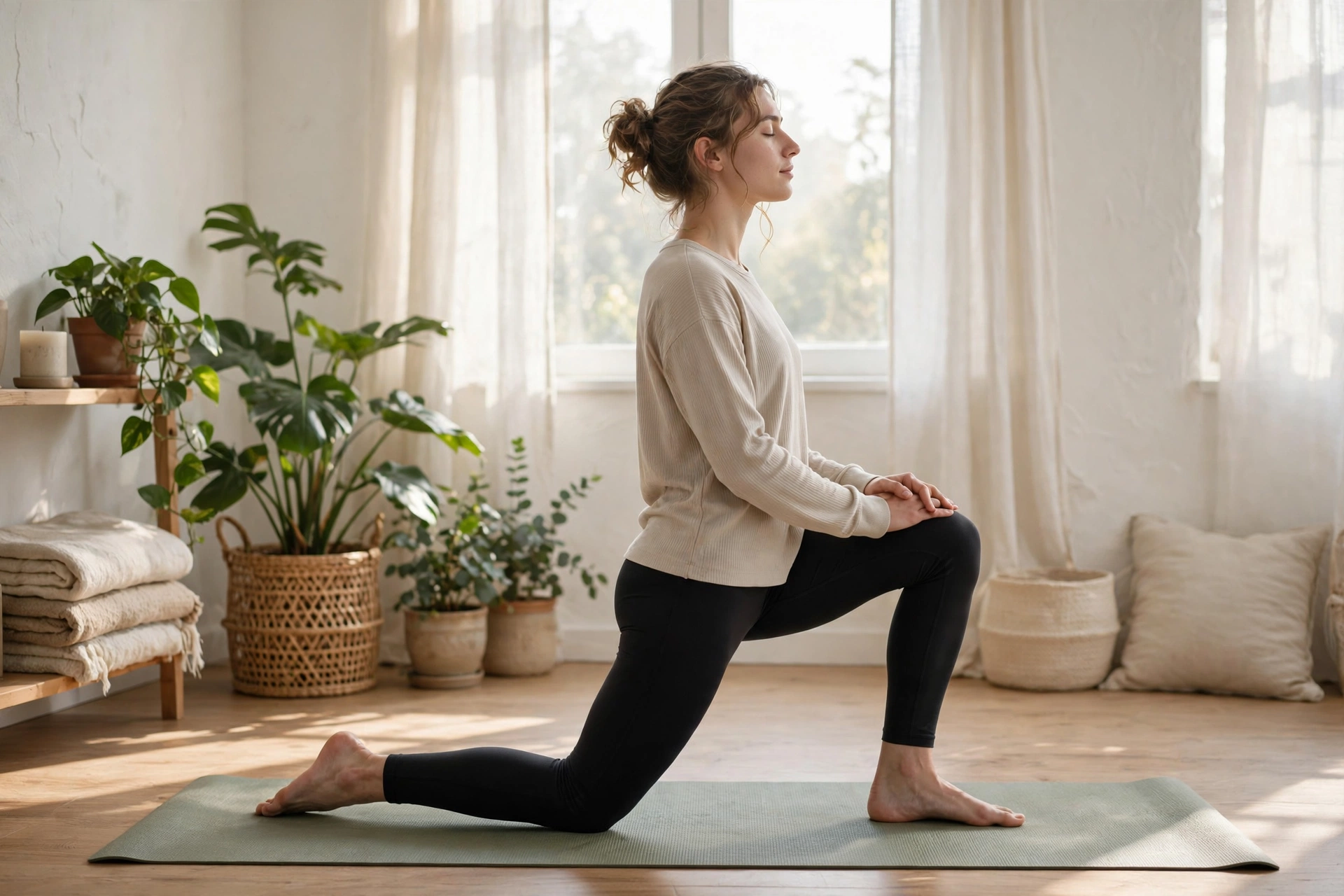
10. Kneeling hip flexor stretch. Half-kneel with your right knee down, left foot forward. Tuck your pelvis slightly (imagine pulling your belt buckle up) and shift forward until you feel a stretch at the front of the right hip. Tight hip flexors are the signature adaptation of chair living — this is the single most important stretch for desk workers. Hold 30 seconds per side.
11. Standing calf stretch. Face a wall in a staggered stance, back leg straight, heel pressed into the floor, and lean forward. You will feel it in the calf and Achilles. Tight calves limit ankle mobility and change how you walk. Hold 30 seconds per side, then repeat with the back knee slightly bent to hit the deeper soleus muscle.
How Long to Hold Each Stretch (The Real Numbers)
“Hold for 10 seconds” is the most common stretching advice and it is wrong — too short to produce lasting change. Here is what research suggests:
- Minimum effective dose: 20–30 seconds per stretch. This is where measurable flexibility gains begin.
- Sweet spot for beginners: 30 seconds. Long enough to work, short enough to tolerate while building the habit.
- Stubborn areas (hips, hamstrings): 45–60 seconds, or 2 sets of 30 seconds. Tight tissues need more time under tension.
- Total per muscle group per week: studies suggest around 5 minutes of stretching per muscle group per week drives meaningful flexibility improvement. That is very achievable — a few sessions weekly.
- Frequency beats duration: stretching 10 minutes daily beats 30 minutes once a week. Flexibility adaptations respond to consistent signaling, not occasional marathons.
The intensity rule: stretch to the point of mild tension — about a 5 or 6 out of 10 — never to pain. Pain triggers a protective muscle contraction (the stretch reflex), which is the opposite of what you want. If you are grimacing or holding your breath, back off. Discomfort that eases as you hold is fine; sharp, shooting, or joint pain is a full stop.
How to Breathe While You Stretch
Breathing is the difference between fighting your body and cooperating with it. Most beginners hold their breath while stretching, which tenses everything and defeats the purpose.
The pattern: inhale deeply through your nose as you ease into the stretch, then exhale slowly through your mouth as you settle deeper. Each exhale is an invitation to release a little further — not by forcing, but by letting the muscle yield. Four to six slow breath cycles per 30-second hold is about right.
Why it works: slow exhalations activate the parasympathetic nervous system — the “rest and relax” branch — which reduces the muscular guarding that resists stretching. You are literally breathing your way past your body’s defenses. This is the same principle behind box breathing for calm and mindfulness practice; stretching done this way doubles as stress relief.
Try this: on your next hip flexor stretch, hold your breath and notice the tension. Then breathe slowly for 30 seconds and notice how much deeper the stretch goes without any extra effort. That difference is the power of breath.
Stretching Mistakes That Cause Injury
Mistake 1: Bouncing (ballistic stretching). Bobbing aggressively at the end range of a stretch triggers the stretch reflex — the muscle contracts to protect itself — and risks micro-tears. The 1980s aerobics video lied to you. Smooth, sustained holds only.
Mistake 2: Stretching cold muscles aggressively. Deep static stretching on completely cold muscles (first thing in the morning, straight off the couch) is the highest-risk scenario. Either warm up with a few minutes of movement first or keep morning stretches very gentle. This is also why our bedtime stretching routine works so well — your body is warm from the day.
Mistake 3: Stretching through sharp or joint pain. Muscle tension = okay. Sharp pain, pinching in a joint, numbness, tingling, or pain that radiates = stop immediately. Stretching should never hurt joints. If a stretch consistently causes joint pain, skip it and consider checking with a physical therapist — some bodies have structural quirks that need professional eyes.
Mistake 4: Only stretching what is tight, ignoring what is weak. Tight hip flexors often pair with weak glutes; tight hamstrings often pair with weak core stability. Stretching the tight part without strengthening its opposite creates imbalance. Pair this guide with bodyweight strength work for the complete fix.
Mistake 5: Rushing. Ten distracted seconds per stretch while scrolling is theater, not training. If you only have five minutes, do three stretches properly rather than twelve poorly. Presence is part of the protocol.
Mistake 6: Stretching an acute injury. Pulled muscle, sprained ankle, inflamed tendon? Do not stretch it — you will make it worse. Acute injuries need rest and professional guidance, not stretching. This guide is for healthy tissue maintenance, not rehab.
Beginners: How to Stretch Properly Every Day
The best stretching routine is the one you will do. Here is how to make it automatic.
Attach it to an existing anchor. After your walk, after your workout, during the evening news, before bed — pick a trigger that already happens daily. Our 10-minute bedtime stretching routine is specifically designed as an evening anchor that also improves sleep.
Start with five minutes. Three stretches done daily beat a 20-minute routine done twice a month. Begin with your three tightest areas (for most desk workers: hip flexors, chest, neck), then expand as the habit solidifies.
Make it pleasant. Stretch on a comfortable mat, play calm music, dim the lights in the evening. If stretching feels like a chore, you will quit; if it feels like a treat, you will crave it. Many people find evening stretching becomes their favorite part of the day — a calming ritual that signals the day is done.
Track flexibility milestones. Can you touch your toes? Sit comfortably cross-legged? These are motivating, visible markers of progress. Note your starting point and retest monthly — the improvement over three months will surprise you.
Final Thoughts
Learning how to stretch properly comes down to a few principles: dynamic before activity, static after (or on warm muscles), 30-second holds, breathe deeply, gentle tension never pain, and consistency over intensity. That is the entire system — everything else is detail.
Start tonight. Pick three stretches from the sequence above — hip flexors, chest doorway, and neck tilt cover the desk-worker’s big three — and hold each for 30 seconds per side while breathing slowly. Five minutes, done. Repeat tomorrow. In a month, your body will feel like a better place to live, and you will wonder why you ever thought stretching was optional.










