
Most first-year herbal brands fail on paperwork rather than on product. The formula is workable, the packaging looks professional and the launch plan is credible, and then a marketplace rejects the listing, a customs hold stops a shipment, or a customer complaint asks for a document that was never created.
Before choosing anything about a storefront, decide the destination market. What counts as a food supplement in one country is a licensed traditional medicine in another, and a botanical with long culinary use in one place is a restricted ingredient in the next. Building a formula before fixing the market produces an expensive rewrite.
Ingredient records are the foundation. A defensible file holds, for every botanical, the plant species and part used, the extraction solvent and ratio, the marker compound and minimum content, the country of origin, a certificate of analysis with heavy metals and microbial limits, and an allergen statement. Where a species is protected or endangered, documentation of legal sourcing is also required.
Identity testing is the practical defense against substitution. Herbal raw material is the ingredient class most often replaced, extended or mislabeled, and a brand that cannot show species verification has no answer when a distributor asks. Simple protocols such as macroscopic and microscopic examination, thin-layer chromatography fingerprinting, or a marker assay each cost little at batch level.
The label is where a product either clears review or does not. Structure-function language describes a role in the body, and disease language, treatment claims and comparisons to prescription drugs do not belong on a supplement. A careful how to sell herbal supplements online process begins from a written claim set reviewed per market, then builds product pages from it rather than the other way round.
Marketplace rules are stricter than the law in practice. Category reviewers remove listings for wording that regulators would tolerate, and the appeal process is slow. Reading the specific category policy, matching its permitted phrasing, and keeping images free of claimed results prevents most takedowns.
Testing before listing should include a finished-product assay of declared actives, microbial limits and a heavy metals panel. A third-party certificate with a named method is worth more than a supplier statement, and it is what a large retail buyer asks for first.
Shipping assumptions need heat. Herbal capsules and gummies cross a warehouse in July, and gelatin shells soften, gummies fuse and volatile botanicals shift odor. Barrier packaging, a desiccant and a summer-safe box size are cheap compared with a wave of returns in August.
Pricing is mostly a COGS conversation with four inputs: unit fill cost, packaging, testing and freight. A brand that prices from a competitor’s retail number rather than from landed cost will discover the difference at the reorder point, when a raw material moves and the margin has nowhere to go.
Returns and complaints need a documented batch trail from the start. Retained samples, batch numbers printed on the pack, and a record linking the finished lot to its raw material lots convert an accusation into an investigation, which is the difference between a resolved complaint and a withdrawn product.
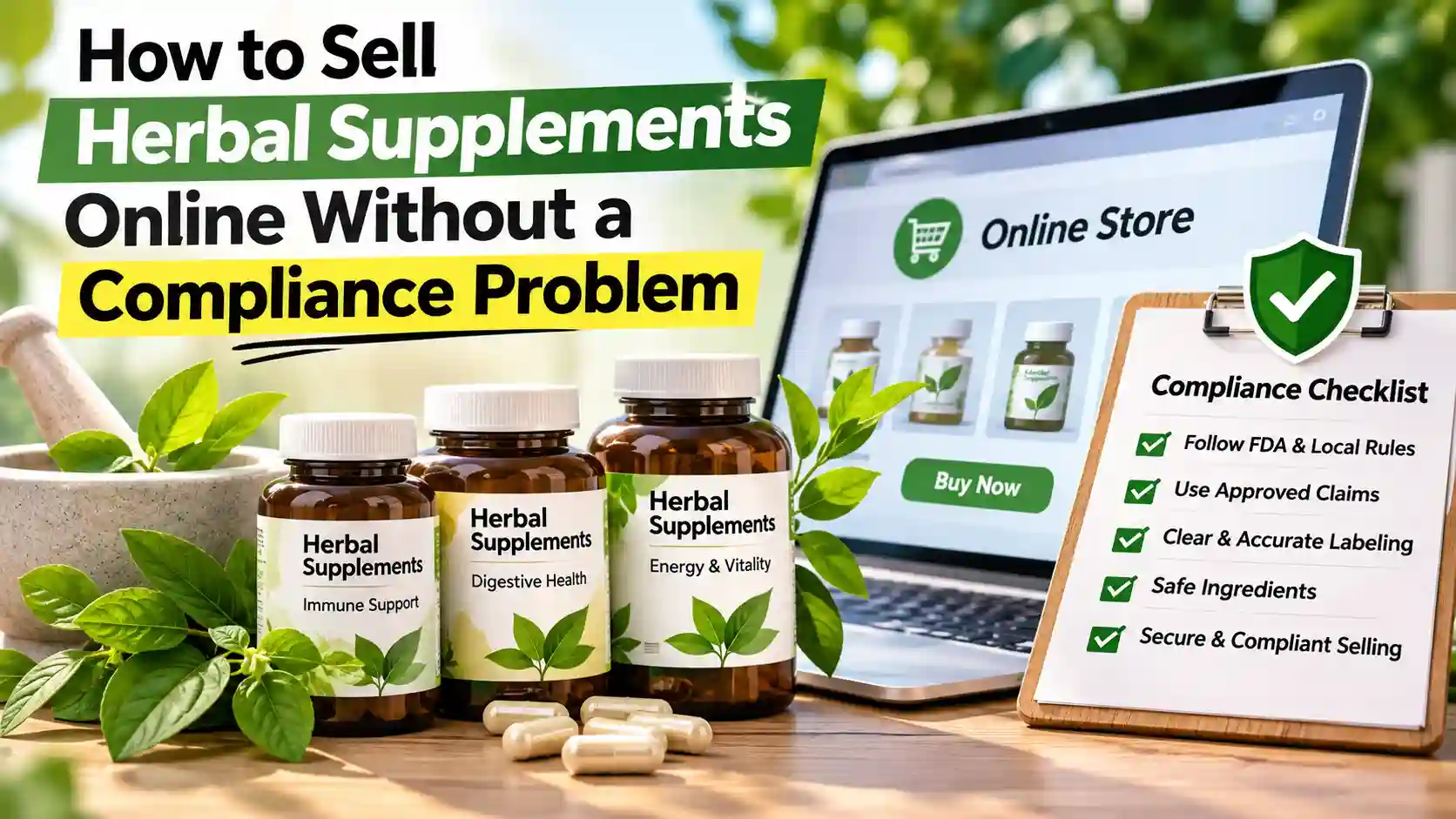
The checklist that survives contact with customers is short. Market decided first, ingredient files complete, identity verified, claim set reviewed per market, finished product tested, packaging able to survive a hot quarter, batch traceable. A brand that can produce all seven can list almost anywhere, and one that cannot will spend its first year explaining paperwork.
Build the compliance file as a folder with one subdirectory per product, holding the ingredient certificates, the finished product analysis, the reviewed claim list, the label artwork and the retention sample log. When a marketplace, a distributor or a regulator asks, a complete folder answers in an afternoon; a search through email threads answers in a month.










