
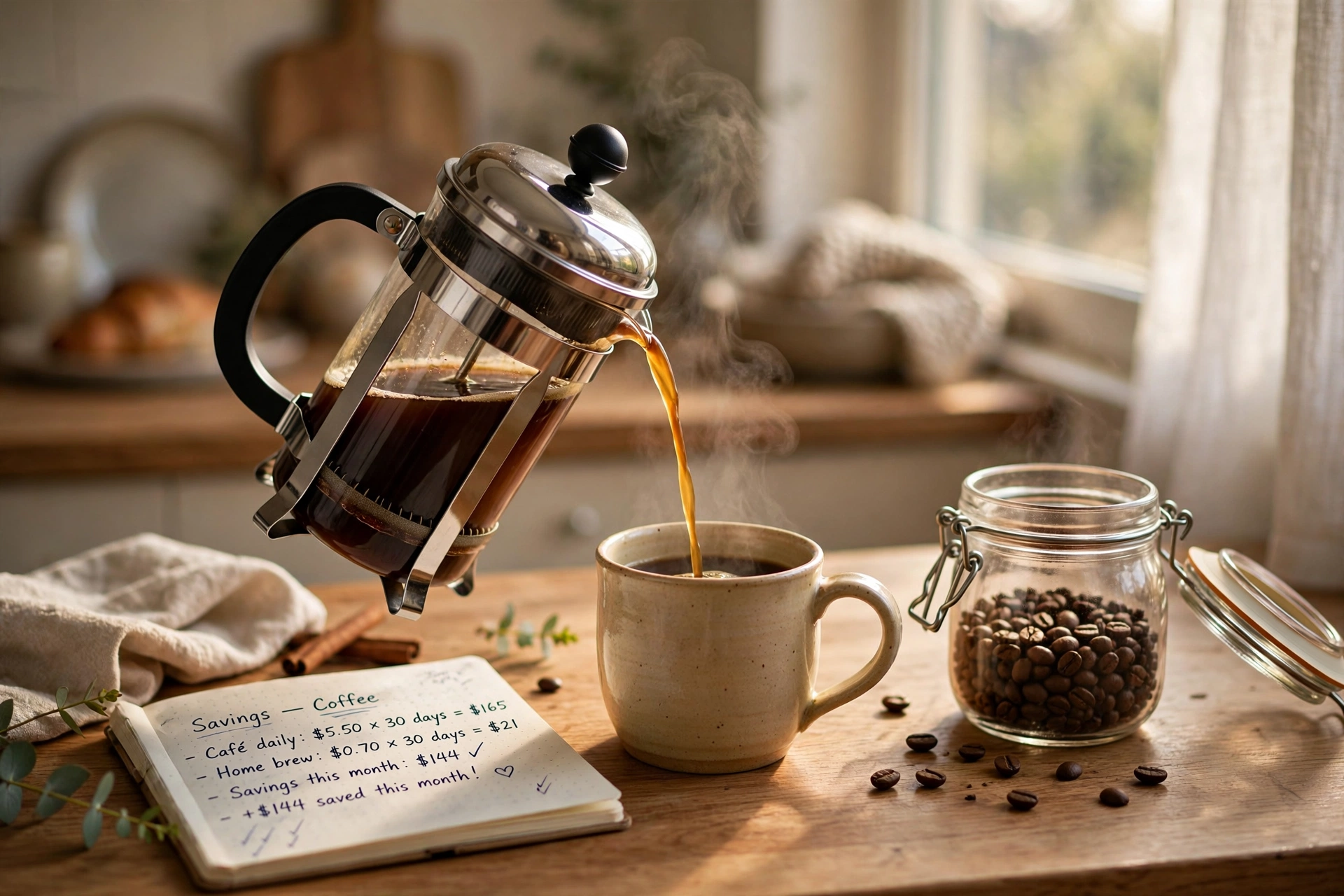
That $5.75 latte feels like a small daily treat — until you do the math. If you are wondering how much does daily coffee cost yearly, the answer stuns most people: a single daily café coffee runs $1,500–$2,200 a year, and for couples or two-a-day drinkers it can top $4,000. This is not an anti-coffee lecture — it is an honest look at the numbers, plus practical alternatives that keep the ritual and cut the cost.
Below you will find the real yearly math at every spending level, what that money could become if redirected, the psychology of why small daily purchases hurt so much, and a tiered plan of coffee alternatives — from home brewing that rivals the café to smart compromises for people who will never give up the shop entirely.
How Much Does Daily Coffee Cost Yearly? The Real Math
Let us run the numbers honestly, using typical 2026 US café prices:
- Drip coffee, daily ($3.50): $3.50 × 365 = $1,278/year
- Latte, daily ($5.75): $5.75 × 365 = $2,099/year
- Large specialty drink, daily ($7.00): $7.00 × 365 = $2,555/year
- Latte, weekdays only ($5.75 × 260): $1,495/year
- Two-a-day latte habit: $4,198/year
- Couple, one latte each daily: $4,198/year
And those are base prices — add tips, the pastry you grab “while you are there,” and price creep, and most daily buyers spend 15–25% more than the drink math suggests. The pastry effect is real: a $3 croissant alongside the latte adds another $1,095 a year.
Compare that to home brewing: quality beans ($15–$20/pound, ~30 cups per pound) plus milk and minimal equipment puts a home latte at roughly $0.75–$1.25. Daily home lattes cost $275–$455 a year — a savings of $1,600+ annually versus the café. That gap is why coffee is the poster child of the “latte factor”: small, frequent, and almost entirely replaceable spending.
What That Money Could Become Instead
Numbers motivate when they connect to goals. That $2,099 annual latte bill, redirected:
- To an emergency fund: a fully funded $2,000 starter emergency fund in under a year — from coffee money alone.
- To automated savings: $175/month into automated savings becomes $2,100 a year without a single moment of deprivation-feeling, because the home coffee ritual replaces it.
- To debt payoff: an extra $175/month against a credit card at 24% APR saves hundreds in interest and months of payments.
- To investing: $2,100/year invested at a hypothetical 7% average return becomes roughly $30,000 over 10 years. Past performance does not guarantee future results — but the math of compounding rewards every redirected dollar.
- To experiences: it is also a vacation. Our guide to planning an amazing vacation on a tight budget shows what $2,000 buys in travel — the latte money literally funds the trip.
The point is not that coffee is bad. The point is that $2,100 is real money making real trade-offs invisible. Once you see the trade, you can choose consciously — which is all any good budget asks. If you have not built one yet, start with a budget you will actually stick to and give coffee its own honest line.
Why Small Daily Purchases Hurt More Than Big Ones
Behavioral economists have a name for this: the pain of paying fades with repetition. The first $6 latte stings; the 200th is invisible. Daily purchases bypass the deliberation that big purchases trigger — nobody comparison-shops a latte — which is exactly why they are the most dangerous budget leak. You scrutinize a $400 TV for weeks while $2,000 in coffee flows past unexamined.
Subscriptions and habits share this invisibility, which is why a subscription audit pairs so well with a coffee audit: both hunt spending that continues purely by momentum. And the fix for both is the same — make the invisible visible (track it for two weeks), then decide deliberately.
There is also identity involved. “I am a latte person” feels like self-expression, and the café ritual — the barista, the cup, the break — delivers genuine psychological value: a pause, a treat, a small luxury. Smart alternatives preserve the ritual while changing the economics. Deprivation fails; substitution succeeds.
The Home Brewing Setup That Actually Rivals the Café
Bad home coffee is why people keep going to cafés. Good home coffee ends the debate. You do not need a $700 espresso machine — you need the few things that actually matter:
- Fresh, decent beans. This is 80% of the game. Buy whole beans from a local roaster or quality grocery brand, and grind just before brewing. Stale pre-ground coffee is why home cups disappoint.
- A burr grinder. The single biggest upgrade. Consistent grind = even extraction = café flavor. A $40–$60 entry burr grinder transforms every brew method.
- Your preferred brewer. French press ($30) for rich full cups, pour-over ($25) for clean bright cups, moka pot ($35) for strong espresso-like coffee, or cold brew (a jar + fridge = nearly free). Match the method to the drinks you actually order.
- A milk frother. A $15 handheld frother plus heated milk makes genuinely good lattes and cappuccinos. The $5.75 café latte is mostly milk, espresso, and foam — all reproducible at home.
- Flavor syrups. A $8 bottle of vanilla or caramel syrup makes dozens of flavored drinks at pennies per pump.
Total startup: $100–$150 for a setup that pays for itself in under a month of skipped café visits. The per-cup cost drops to under a dollar, and the 10-minute morning ritual — grinding, brewing, frothing — becomes its own pleasure. Many converts report they prefer their home coffee within weeks, because it is made exactly how they like it, every time.
How Much Does Daily Coffee Cost Yearly If You Never Quit the Café?
Not everyone wants to become a home barista, and that is fine. Middle paths cut costs 50–70% while keeping the café in your life:
- The 2-day rule: café coffee twice a week (say, Tuesday/Friday treat), home coffee the rest. Savings: ~70%.
- Downsize the order: a small instead of a large, drip instead of latte, black instead of flavored. A $3.50 drip habit costs $800/year less than a $5.75 latte habit — same café, same ritual.
- Loyalty programs, used properly: café apps with stars and free-drink rewards genuinely cut 10–15% — but only if you were buying anyway. Never let rewards justify extra visits.
- The office upgrade: if your workplace has bad free coffee, a $30 French press at your desk plus good beans beats the café run and the break-room sludge alike.
- Social coffee, solo home coffee: keep café visits for the social ones — meeting a friend, the weekend treat — and drink home coffee alone at the desk. You keep 100% of the ritual value at 30% of the cost.
- Batch cold brew: a Sunday 5-minute prep yields a week of smooth, strong cold brew at ~$0.40/cup. It is the lowest-effort home option and ideal for iced-coffee loyalists.
The principle: design the compromise you will actually keep. A 70% reduction sustained for years beats a 100% elimination abandoned in February. This is the same philosophy behind the 30-day rule — systems you can live with beat perfect plans you cannot.
Run Your Own Coffee Audit (15 Minutes)
Do not guess — measure. This week:
1. Pull two weeks of statements. Highlight every coffee purchase, including the pastries and tips. Total it and multiply by 26 for the annual number. Most people underestimate by 30–50%.
2. Name the trade-off. Write down what that annual number equals in your life: “My coffee = our vacation fund” or “My coffee = the emergency fund.” Concrete trade-offs beat abstract guilt.
3. Choose your tier. Full home brewing, the 2-day compromise, or just downsizing orders — pick the biggest change you will actually sustain.
4. Redirect the savings immediately. Set up the automatic transfer for the monthly savings amount before the habit change, so the money is captured, not absorbed. This is the automate your savings principle applied surgically to one habit.
5. Re-audit quarterly. Habits drift. A 5-minute quarterly check keeps the savings honest — and watching the redirected savings grow is powerfully motivating.
Couples should do this together — coffee is often a shared ritual, and setting financial goals together as a couple turns the audit into teamwork instead of blame. Nobody is the “coffee villain”; you are partners optimizing a shared budget.
Beyond Coffee: Finding Your Other Latte Factors
Coffee gets the fame, but the audit method works on every small recurring purchase: the daily energy drink, the lunch-out habit, the app subscriptions, the convenience-store snacks. Each one feels tiny; together they are often $300–$500 a month.
Run the same 15-minute audit on your top three recurring small purchases. You will usually find one more “coffee” hiding in the statements — and the same tiered approach (substitute, reduce, redirect) works for all of them. Combined with simple ways to save money every month and a clear-eyed grocery strategy, these micro-optimizations compound into a savings rate that feels effortless because no single change felt like sacrifice.
The ultimate lesson of the latte factor was never “stop enjoying coffee.” It is this: small money is still money, and conscious money beats unconscious money every time. Audit it, choose deliberately, and redirect the difference toward the life you actually want.
What You Are Really Paying For (and Cheaper Ways to Get It)
The drink is only part of the purchase. Understanding the real product helps you replace it without feeling deprived:
- The “third place.” Cafés sell a place that is not home or work — comfortable, buzzy, with good Wi-Fi. Cheaper version: libraries with café corners, park pavilions, or a friend’s porch. Many co-working spaces offer day passes cheaper than a week of lattes.
- The break ritual. Stepping out mid-morning resets the brain. Cheaper version: a 10-minute walk with your home-brewed travel mug. Studies suggest the walk delivers more of the reset than the beverage does.
- The barista relationship. Being known somewhere feels good. Cheaper version: become a twice-a-week regular instead of a daily one — you keep the relationship at 30% of the cost, and honestly, the baristas prefer the regulars who are not rushed.
- The taste. Genuinely good coffee matters to aficionados. Cheaper version: invest the first month’s savings in great beans and a grinder. Most daily café drinkers discover home coffee made right beats the chain’s version — chains optimize for speed and consistency, you optimize for your palate.
- The status signal. Let us be honest: the cup with the logo signals something. Cheaper version: a beautiful reusable cup signals taste and values — and many cafés discount refills in your own cup, stacking savings on the visits you keep.
When you decompose the purchase, you find that the $5.75 buys maybe $1 of coffee and $4.75 of atmosphere, ritual, and identity. Keep buying the parts you value — the twice-weekly third place, the social coffee — and stop paying café prices for the parts you can reproduce at home for pennies. That is not frugality as punishment; it is spending with surgical precision on what actually makes you happy.
One more reframe: nobody needs permission to enjoy a daily latte — if it is in the budget and it genuinely makes your mornings better, it is money well spent. The audit is not about guilt; it is about making sure the $2,100 is a choice, not a leak. Conscious spending on things you love, ruthless cutting of things you do not notice — that is the entire philosophy.
Final Thoughts
So how much does daily coffee cost yearly? $1,300 for drip, $2,100 for lattes, $4,000+ for heavy habits — real money with real alternatives. Home brewing cuts the cost 80% while keeping (or improving) the ritual; smart compromises cut it 50–70% for café loyalists. Either way, the win is not deprivation — it is consciousness.
Run the 15-minute audit this week, pick your tier, and automate the savings. A year from now you will have the coffee you love and the $2,000 doing something better. That is not giving something up — that is getting something better.










