
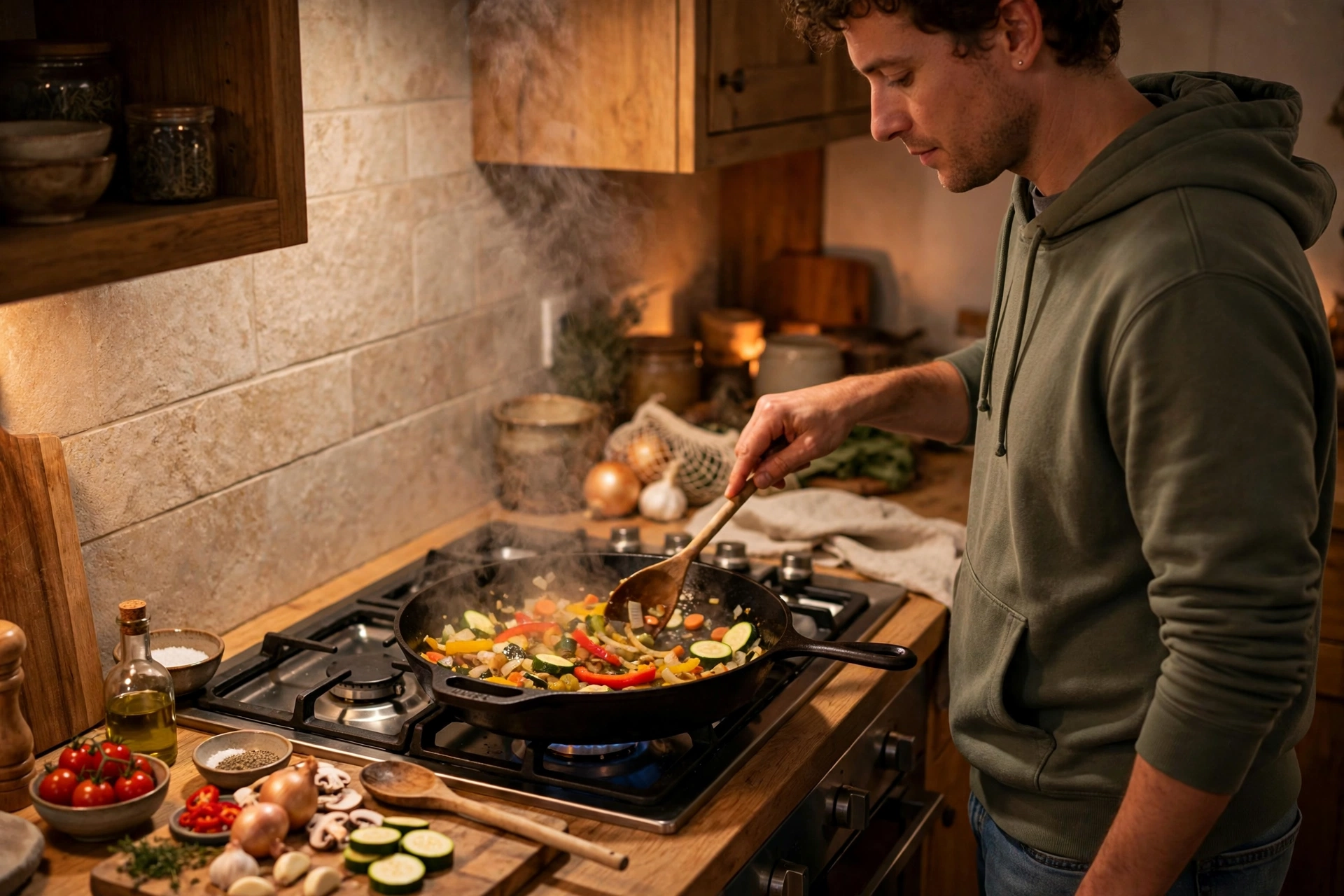
You know home cooking is healthier and cheaper. You have the recipes saved, the good intentions, and maybe even a cart full of groceries that slowly wilted while you ordered takeout. If takeout apps know your order by heart and your stove is mostly decorative, this guide on how to cook at home more often was written for you — especially if you genuinely dislike cooking.
Here is the liberating truth: you do not need to love cooking to cook at home regularly. You need systems that make it fast, easy, and barely noticeable — the culinary equivalent of brushing your teeth. This guide is not for food lovers. It is for busy, tired, cooking-averse humans who want the benefits of home-cooked meals (better health, more money, less guilt) without the hobby. Let us build you a low-effort kitchen life.
Why You Hate Cooking (and Which Barrier Is Yours)
“I hate cooking” usually means one of five specific things, and the fix depends on which one is yours. Identify your barrier honestly.
Barrier 1: It takes too long. You are picturing hour-long recipes with 20 ingredients. The fix: a personal rule that weeknight cooking never exceeds 20–30 minutes — which is entirely possible, as you will see below.
Barrier 2: Decision fatigue. “What should I make?” is the hardest part of cooking. The fix: a small rotation of go-to meals and a weekly plan, so deciding happens once, not nightly. This is where meal prep basics earns its keep.
Barrier 3: The cleanup. You do not hate cooking; you hate the mountain of dishes. The fix: one-pot and sheet-pan cooking (see our easy healthy one-pot dinners), cooking in parchment, and the “clean as you go” habit that makes the final wash-up trivial.
Barrier 4: You are bad at it. Past failures — burnt pans, bland chicken, smoke alarms — killed your confidence. The fix: start with foolproof methods (roasting, slow cooking, stir-frying) that are nearly impossible to ruin, and follow recipes exactly until your instincts develop.
Barrier 5: It feels lonely and boring. Standing alone in a kitchen chopping vegetables is nobody’s idea of fun. The fix: podcasts, audiobooks, music, or a cooking buddy — and reframing cooking as 20 minutes of screen-free decompression rather than a chore.
Most cooking-haters have two or three of these barriers stacked. The strategies below address all five simultaneously.
How to Cook at Home More Often: The 20-Minute Rule
Adopt this as law: on weeknights, no meal takes longer than 20 minutes of active work. (Oven time does not count — you can be on the couch while things roast.) This single rule eliminates the biggest objection to home cooking, because 20 minutes is less time than delivery takes to arrive.
Twenty-minute meals are not a compromise — they are a category. Stir-fries: sliced protein + frozen stir-fry vegetables + bottled sauce over instant rice, done in 15 minutes. Tacos: seasoned ground turkey or black beans, tortillas, and whatever toppings exist. Pasta with jarred sauce bulked up with frozen spinach and white beans. Omelets or frittatas with whatever vegetables are dying in the crisper. Sheet-pan dinners: protein and chopped vegetables on one pan, 425°F, 25 minutes of ignoring it.
The secret weapon of 20-minute cooking is the strategic shortcut pantry: frozen vegetables (nutritionally equal to fresh), pre-minced garlic, jarred sauces, canned beans, rotisserie chicken, frozen shrimp, instant rice and couscous. These are not cheating — they are the reason busy people can cook at all. Purists can keep their from-scratch dogma; you are optimizing for done, a philosophy shared with easy food swaps that prioritize sustainability over perfection.
How to Cook at Home More Often With a 10-Recipe Rotation
The decision problem — “what’s for dinner?” — kills more home-cooking intentions than any other barrier. The solution is a personal rotation: 8–10 meals you know by heart, like enough to repeat, and can make half-asleep. Write them down. Stick the list on the fridge. When the list exists, dinner is a selection, not an invention.
Your rotation should span categories so the week has variety: two or three 20-minute skillets or stir-fries, two sheet-pan or one-pot meals, one pasta night, one taco/bowl night, one breakfast-for-dinner, one slow-cooker or soup day, and one “assembly only” meal (rotisserie chicken + bagged salad + microwaved grain — cooking barely required). Build each meal around the plate method and balance takes care of itself.
How to build the list: think about what you actually order for takeout, then find the 20-minute homemade version. Love pad thai? A peanut-sauce noodle stir-fry at home takes 15 minutes. Love burrito bowls? Rice, beans, rotisserie chicken, salsa, and cheese — assembled, not cooked. Your rotation should reflect your cravings, because the goal is replacing takeout, not replacing joy.
Revisit the rotation seasonally. Retire anything you have grown sick of, promote any experiment that worked, and add one new recipe per month maximum. Slow evolution beats constant novelty — familiarity is what makes weeknight cooking feel effortless.
Set Up Your Kitchen for Reluctant Cooks
Your kitchen is either helping you or fighting you. A reluctant cook needs a kitchen optimized for minimum friction.
Keep the essentials visible and the clutter hidden. The tools you use daily — a good chef’s knife, a cutting board, one large skillet, one sheet pan, one pot — should be within arm’s reach. Specialty gadgets you use twice a year belong in a cabinet, not on the counter stealing your motivation.
Sharpen your knife. This sounds minor and is actually transformative. A sharp knife makes chopping fast, safe, and almost pleasant; a dull knife makes it slow, dangerous, and miserable. If your knife cannot slice a tomato cleanly, it is sabotaging your cooking life.
Stock the shortcut pantry. Olive oil, salt, pepper, garlic powder, a couple of spice blends you love, soy sauce, canned tomatoes, canned beans, broth, pasta, rice, frozen vegetables, eggs, and one or two jarred sauces you genuinely like. With this inventory, you are never more than 20 minutes from dinner, no recipe required.
Make cleanup painless. Line sheet pans with parchment or foil. Soak the skillet while you eat. Keep the dishwasher empty enough to load as you go. The people who cook regularly are not people who love dishes — they are people whose cleanup takes five minutes because the system handles it.
Shortcuts That Are Totally Fine (Stop Feeling Guilty)
Let us officially retire the guilt around cooking shortcuts. Every item below is used by busy professional chefs at home, and each one buys you home-cooked meals on nights you would otherwise order out.
Rotisserie chicken. The single greatest shortcut in the grocery store. Instant protein for salads, tacos, soups, grain bowls, and sandwiches — often cheaper than raw chicken per pound. Buy one weekly and build around it.
Frozen vegetables and fruit. Picked at peak ripeness and frozen immediately, often more nutritious than “fresh” produce that traveled for a week. Zero washing, zero chopping, zero waste. Keep five varieties in the freezer always.
Pre-cut fresh vegetables. Yes, they cost more. They also get eaten instead of rotting whole in the crisper. If pre-cut is the difference between cooking and not cooking, it is the best money you spend all week.
Jarred sauces and spice blends. A good marinara, curry simmer sauce, or taco seasoning does 80% of the flavor work. Doctor them up with fresh garlic, lemon, or herbs if you feel fancy — or do not. Dinner is dinner.
Microwave grains and frozen rice. Ninety-second rice packets and frozen grain blends eliminate the most boring 20 minutes in cooking. The nutritional difference versus stovetop rice is negligible; the behavioral difference is enormous.
The principle: a shortcut that gets you cooking beats a from-scratch ideal that keeps you ordering takeout. Every single time. If cooking with whole foods is your aspiration, shortcuts are the on-ramp, not the enemy.
Cook Once, Eat Twice (or Thrice)
The highest-leverage habit for cooking-haters: never cook a single meal. Every time you turn on the stove or oven, make double — or triple. The extra effort is maybe 10%, and the payoff is a free future meal.
Doubling works best with: grains (cook a huge pot of rice or quinoa), proteins (roast two sheet pans of chicken, brown double ground turkey), roasted vegetables, soups and stews, and sauces. Tonight’s roast chicken becomes tomorrow’s tacos becomes Thursday’s soup. This is not leftovers-as-punishment; it is intentional second meals planned from the start.
The freezer is your time machine. Soups, stews, cooked grains, shredded chicken, and burritos all freeze beautifully for weeks or months. A freezer stocked with three or four homemade options is an insurance policy against every “too tired to cook” night. Label and date everything — future you will not remember what the mystery container is.
This habit is the bridge to meal prep basics: once you are comfortable doubling dinners, you are one small step from a dedicated prep session. But even without formal meal prep, cook-once-eat-twice cuts your cooking nights nearly in half.
Make It Enjoyable (or at Least Tolerable)
You may never love cooking, and that is fine. But you can make the 20 minutes pleasant instead of miserable.
Stack it with entertainment. Cooking time is perfect podcast, audiobook, or playlist time. Save a show you love exclusively for cooking sessions — suddenly the kitchen has a reward attached. Many reluctant cooks report this single change flipped their attitude.
Cook with someone. A partner, a kid old enough to stir, a friend on speakerphone, a weekly cooking date. Company transforms cooking from solitary chore to social time — and shared cooking means shared cleanup.
Lower the bar gloriously. Give yourself full permission to make “boring” food. Scrambled eggs and toast is dinner. A quesadilla is dinner. Rotisserie chicken with bagged salad is dinner. The meals do not need to impress anyone — they need to exist. Instagram-worthy is not the goal; fed is the goal.
Track the money. For one month, note what you spend on takeout versus groceries. Most cooking skeptics convert permanently when they see the number — home cooking typically costs a third to a quarter of delivery per meal. Our guide to meal planning to save money and cutting your grocery bill will stretch those savings further. Nothing motivates like watching hundreds of dollars stay in your account.
Stretch Every Cooking Session Further
Once you are cooking even a few nights a week, a few extension habits multiply the payoff without multiplying the effort. First, think beyond dinner: the same 20-minute skills cover breakfast and lunch too. A batch of hard-boiled eggs, overnight oats, or a simple egg-and-vegetable scramble turns chaotic mornings into non-events — our healthy breakfast ideas for busy mornings are built for exactly this kind of low-effort cooking.
Second, let dinner cook your lunch. When you make double portions (the cook-once-eat-twice habit), pack tomorrow’s lunch before you sit down to eat — not after, when motivation is gone and the couch is calling. A packed lunch waiting in the fridge is worth more than the healthiest intentions, and our guide to packing a healthy lunch you’ll actually eat shows how to make packed lunches you look forward to instead of endure.
Third, waste nothing. Cooking-haters often waste the most food, because good intentions at the grocery store meet zero motivation at the stove. The fix is buying with a plan: shop from your 10-recipe rotation, prep what you buy within two days, and turn wilting vegetables into soup, stir-fry, or frittata before they turn. Our guide to reducing food waste at home pairs perfectly with reluctant-cook systems — less waste means less money lost, which is its own motivation to keep cooking.
Final Thoughts
Learning how to cook at home more often — when you hate cooking — is not about becoming a food person. It is about building a low-friction system: a 20-minute rule, a 10-recipe rotation, a shortcut-stocked kitchen, and the cook-once-eat-twice habit. None of this requires talent, passion, or a free weekend. It requires about as much enthusiasm as doing laundry — and delivers far better returns.
Start tonight, not next month. Pick one 20-minute meal from your existing cravings, buy the shortcut ingredients, and make it. Then make double. Notice that it took less time than delivery, cost a third as much, and tasted like food made for you — because it was. Do that a few times a week, and the stove stops being decorative. It becomes yours.










